


Iterative Design
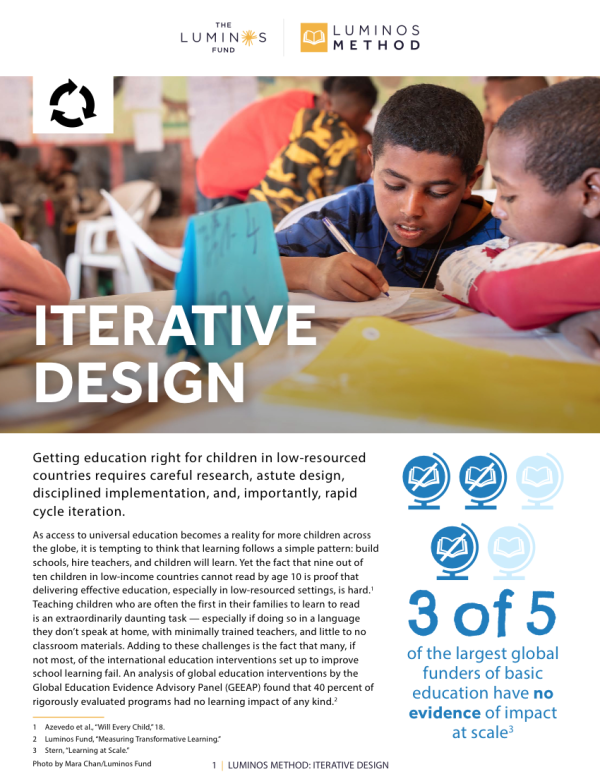
Delivering effective education, especially in low-resourced settings, is hard. The fact that nine out of ten children in low-income countries cannot read by age 10 is a testament to this challenge. Adding to these difficulties is the reality that many, if not most, international education interventions set up to improve school learning fail. Currently, three out of five of the largest global funders of basic education have no evidence of impact at scale. Unlike, say, protecting people from polio, education reform is not solved primarily through one magic formula that is guaranteed to deliver the same impact to every child, regardless of context. The best vaccinations provide immunity against a disease whether the person lives in the United States or in The Gambia. In contrast, effective global learning programs for children recognize that the impact on children’s learning is a result of multiple variables and contexts best suited to an iterative design approach.
Getting education right for children in low-resourced countries requires careful research, astute design, disciplined implementation, and, importantly, rapid cycle iteration. Yet all too often, the dominant model for non-governmental organizations (NGOs) is a model in which success is measured by a program’s adherence to the original design plans rather than student learning gains.
For the Luminos Fund, iterative design is a core component of our identity and approach. Recent research results of our work demonstrate the powerful impact of our approach on student learning. The Iterative Design element of the Luminos Method details how we have established this culture and capacity. In sharing our experience, we fulfill a key element of learning organizations, which is to widely share our solutions with all those who are invested in figuring out what works in global education reform.
- 54 vues