


Safely at School: Reducing Risks of School-related Gender-based Violence for Children with Disabilities in Sierra Leone
Globally, school-related gender-based violence (SRGBV) impacts 246 million children and
adolescents a year. UNESCO defined SRGBV as “acts or threats of sexual, physical or
psychological violence occurring in and around schools perpetrated as a result of gender
norms and stereotypes and enforced by unequal power dynamics”. SRGBV includes
violence at school, but also violence related to educational participation, such as bullying or
physical or sexual assault on the way to/from school. Annually, an estimated 60 million girls
experience sexual assault on their way to/from school. Measuring SRGBV is difficult, and we
have limited insight into how it affects children with disabilities in particular.
Gender-based violence (GBV) is widespread in Sierra Leone and is deeply rooted in social
and economic inequalities. Societal gender norms prevent equitable access to education,
which in turn perpetuates high levels of GBV, early marriage and teenage pregnancy. A
2010 survey found that 90 per cent of children in the country had experienced physical
violence at school, and almost 80 per cent had experienced corporal punishment. Over 40
per cent of girls had experienced sexual violence and 18 per cent had been raped – one
third of these at or around schools. Multiple studies show that SRGBV contributes to girls
leaving school in early adolescence.
Recent work in Sierra Leone has identified various forms of SRGBV in schools, including
corporal punishment, sexual threats by teachers, and bullying and sexual harassment by
peers. Within communities, girls experienced sexual exploitation in exchange for lunch, and
for transport to and from school. However, little is known about how SRGBV affects children
with disabilities in Sierra Leone.
The aim of this study was to understand and articulate the experiences, perceptions, needs
and concerns of boys and girls with disabilities regarding SRGBV in Sierra Leone. Initial
findings were used to work with school communities to co-develop disability-inclusive
SRGBV response strategies.
The study addressed the following questions:
- How do boys and girls with disabilities attending inclusive schools in Sierra Leone
perceive and experience school-related gender-based violence? How do these views
and experiences vary between boys and girls? - Where do these children feel more and less safe? Where are hotspots of violence or
perceived risks to safety? Where do children feel most safe and protected? Where
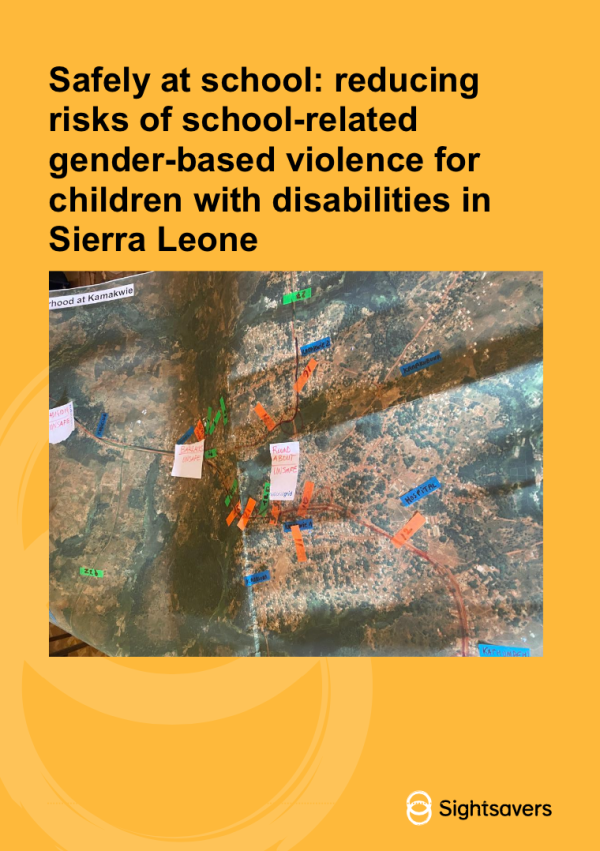
possible, we explore variations on the basis of sex, age and type of disability. - What do children think would help make these spaces safer, and who do they see as the main agents of change? What are the perspectives and opinions of other stakeholders within school communities? How can sharing children’s concerns about safety and risk with school communities support the development of responses?
- 52 vues