


Thriving Together: A Monitoring, Evaluation, and Learning (MEL) Toolkit for ECD Practitioners
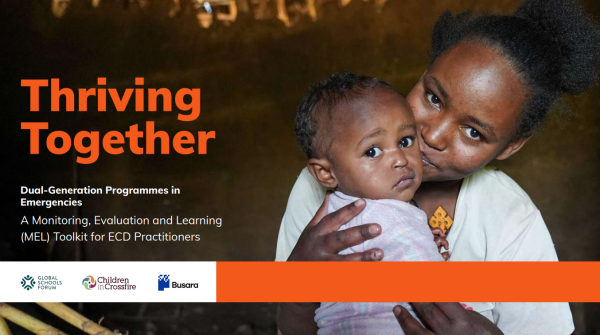
The first years of life are the most important for a child’s development, making young children vulnerable to emergencies. Caregivers are instrumental in safeguarding young children, but are often unable to provide nurturing support due to their own challenges like poor mental health, limited livelihood opportunities, poor access to public services etc.
As the wellbeing of young children and caregivers is interlinked, dual-generational (referred to as dual-gen hereon) programmes, which aim to simultaneously and intentionally address the needs of both children and their caregivers, becomes essential.
The past decade has seen a rise in global emergencies, impacting millions. Dual-gen programmes are even more relevant in this context. While the approach has gained prominence in the US, there is a lack of evidence of “what works” in emergency and low-resource contexts. A salient barrier, identified through interviews with practitioners, is the absence of appropriate measurement tools and guidance for programmes that are focusing (or want to focus) on both child and caregiver outcomes.
Recognising this, the Global Schools Forum (GSF), Children in Crossfire, and the Busara Center for Behavioral Economics partnered to develop a monitoring, evaluation and learning (MEL) toolkit.
This resource aims to guide practitioners working in emergencies in developing and measuring dual-gen outcomes to inform programme design.
The tools and resources were piloted in the fragile context of Waliso that is characterised by ongoing ethnic tensions, political instability, frequent displacement due to conflict and violence, and limited access to essential services like education and healthcare. While the resources were piloted in a particular context, the toolkit remains relevant across the spectrum of emergencies, including protracted and acute emergencies as many underlying challenges - such as instability, limited resources, and disrupted services - remain similar across different settings. Practitioners in non-emergency low-resource contexts may also encounter similar characteristics and are therefore encouraged to also use this toolkit.
- 34 views