


Teacher-Led Assessment
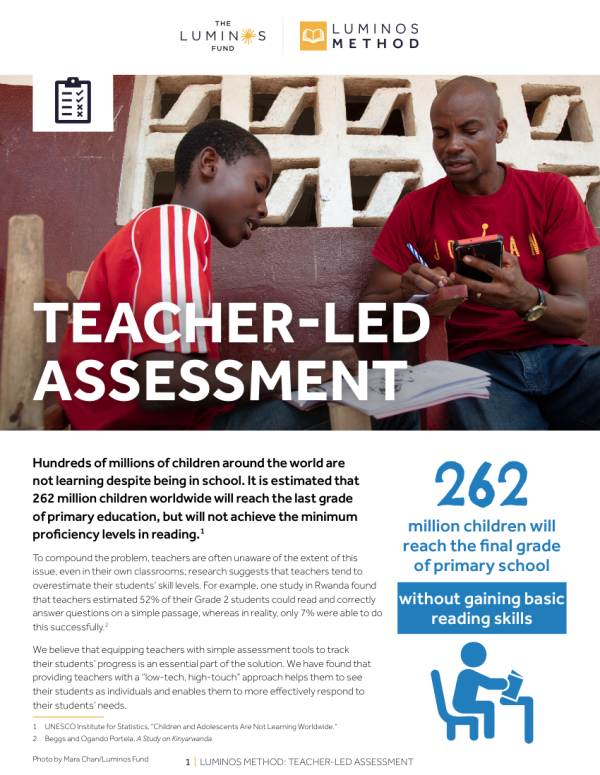
Hundreds of millions of children around the world are not learning despite being in school. It is estimated that 262 million children worldwide will reach the last grade of primary education but will not achieve the minimum proficiency levels in reading. To compound the problem, teachers are often unaware of the extent of this issue, even in their own classrooms; research suggests that teachers tend to overestimate their students’ skill levels. For example, one study in Rwanda found that teachers estimated 52% of their Grade 2 students could read and correctly answer questions on a simple passage, whereas in reality, only 7% were able to do this successfully.
Recognizing the urgent need to address this learning crisis, the international discourse has shifted from a focus on educational access to discussions of quality, with a growing recognition of the importance of measuring learning outcomes when evaluating interventions. While these are important, such evaluations can be likened to a rear-view mirror, providing information about what has already occurred, unable to help students in real-time. For students currently in school, it is essential that their progress is assessed on a regular basis to ensure they get timely support to keep their learning on track.
The Teacher-Led Assessment element of the Luminos Method reflects our experience across multiple country programs, and highlights the best practices in assessment to help keep students’ learning on track. We have found that providing teachers with a “low-tech, high-touch” approach helps them to see their students as individuals and enables them to more effectively respond to their students’ needs. Having teachers lead the collection of this data—rather than program monitoring and evaluation staff—gives them the information that they need to address the learning gaps in their classrooms. This ultimately results in better learning outcomes. In just 10 months, our students are equipped with the skills they need to be successful when they return to mainstream school.
- 81 vistas