


Blog | Child Protection and Education in Emergencies: Integration is more important than ever
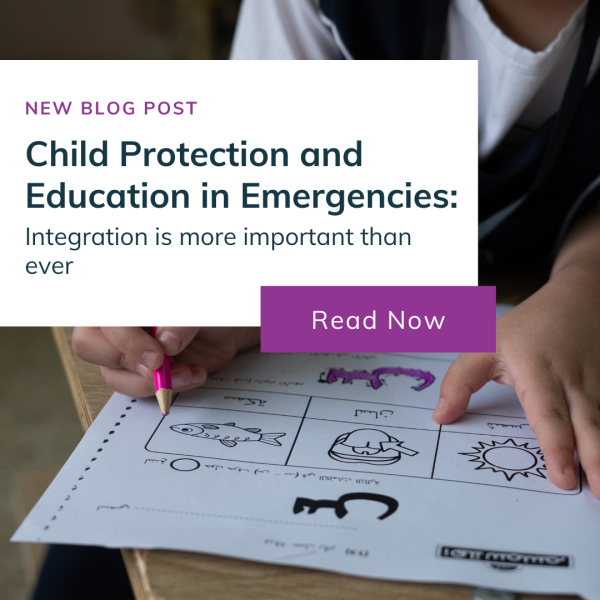
In this time of great uncertainty across the humanitarian sector, children and young people affected by crisis and conflict still need education, and still need protection, regardless of what global structures and funding are in place. It is essential that Child Protection and Education in Emergencies actors work together through joint and integrated programmes to holistically address these needs. The advantages of such collaboration extend beyond improving learning and wellbeing outcomes for children, they also contribute to more streamlined and cost-effective ways of working.
INEE and the Alliance have found that joint and integrated programming can:
- Help mitigate protection risks, improve overall child well-being, and lead to better educational outcomes.
- Increase enrollment and retention in education programming.
- prevent children and young people ‘slipping through the gaps’ between services.
maximise the impact of multiple sector interventions. - Be cost effective and prevent duplication.
- Transform humanitarian delivery, drive cross-nexus approaches and support the localization agenda, for stronger systems and communities in crises.
As we face increasing financial and capacity constraints, it’s more important than ever that we work across silos and place children at the centre of our responses.
INEE and the Alliance came together in 2020 to establish the Child Protection in Humanitarian Action (CPHA)-Education in Emergencies (EiE) initiative, to support better collaboration between child protection and education sectors responding to the needs of children, communities, and systems experiencing crises. We recognised the excellent joint working that was already happening in crises around the world, but wanted to give greater clarity and guidance on how and why cross-sectoral collaboration was critical to meeting the needs of children and young people.
Foundational publications were produced during the first phase. These included a position paper setting out the rationale for collaboration, and an important research paper on the impact of Covid related school closures on education and child protection outcomes. With support from the multi-agency advisory group, the Guidance Note was developed and launched, giving practitioners a set of guidelines and resources to support shared planning and implementation in responses. Throughout, we ensured alignment and complementarity with the Collaboration in Coordination work developed by the Global Education Cluster (GEC) and the Child Protection Area of Responsibility (CPAoR).
In June we reached out to Alliance and INEE members to ensure our next phase was shaped by current realities and experiences of practitioners. First, a workshop was facilitated followed by a widely distributed survey. Both reviewed how integrated and joint programming was progressing, what tools were being used, and what additional resources are required to better support this work. Engagement from both sectors was impressive, with 26 people attending a half day workshop and over 360 practitioners responding to the survey. This not only indicates commitment to joint working, but the enthusiasm and comments remind us that the initiative remains very important and very timely.
Guided by this outreach, we will now focus on organising a wealth of existing resources from members and the two networks, providing some guidance on how and when they can be used, rather than developing new resources. Additionally, we will be supporting advocacy efforts by collecting evidence of what works, and developing related speaking points, and we will compile case studies and tools developed by partner organisations.
We recognise, now more than ever, that working across the nexus is critical. The work produced during this phase of the joint initiative will focus more on supporting the national systems and organizations who serve children and youth across the nexus. Many of these actors instinctively work in a multi-sectoral way as they endeavor to respond to specific needs of children and youth and are well-placed to ensure broader responses are context-specific, culturally relevant, and equitable from anticipatory action and preparedness through response and recovery.
Whatever is decided by the current Humanitarian Reset, the needs of children and young people affected by conflict and crises will not change. Supporting them holistically in these times requires ways of working where global structures don’t dictate the design of programmes, where cross sectoral working is the norm, and where local actors are given the power and resources to work together to ensure better outcomes for the children they serve.
Joint and integrated child-centred programming at local levels is key to ensuring children remain better protected, develop cognitively, socially and emotionally, and can contribute to peace and stability in their communities as they grow up.
You can continue to contribute to this initiative by sharing experiences and tools you use in your own work. We look forward to hearing from you, and collaborating further on this important initiative.
Do you have examples of projects or tools that demonstrate and support joint and integrated programming? Tools may include frameworks and decision-making tools you and your organization use; MEAL tools to understand need, progress, and impact made; operational tools like ToRs or organigrams, and programmatic tools that support specific interventions; case studies, or others. If so, please contact Mark Chapple on mark.chapple@alliancecpha.org
Consultation on experiences and needs, June 2025
A consultative workshop with 26 participants, including facilitators, speakers, donors, INGOs, and one national NGO was facilitated. We acknowledge the participation was heavily skewed to the Global North and organizations that have, to date, claimed leadership roles in global and national level CPHA and EiE work.
To ensure the process and products created in 2025 are guided by broader representation, we circulated a survey to INEE and Alliance members. The survey results gave us a more representative picture of the needs and perspectives of national stakeholders, including national NGOs and government services. A total of 362 Education and Child Protection practitioners responded across the 5 languages (Arabic 61, English 172, French 97, Portuguese 5, Spanish 27). A majority of respondents are based in crisis contexts (64%) with the remaining being evenly split between post-crisis and other at 17% with greater percentages from the Arabic (77%), French (74%) and Spanish (76%) language communities based in crisis contexts. Fifty four percent of the respondents noted they worked across both sectors. Of the remaining half, 38% indicated working in education and 16% in child protection only.
Key Resources shared as part of the survey and available on INEE and Alliance websites:
- INEE–Alliance Guidance Note on Supporting Integrated CP–EiE Programming
- INEE Minimum Standards
- Child Protection Minimum Standards
- Alliance Working Across Sectors resources
- Alliance Training and e-Learning Hub
- INEE’s Learning and Development
- Global Education Cluster (GEC)–Child Protection Area of Responsibility(CPAoR) CP-EiE Collaboration in Coordination Framework
- Global Education Cluster e-learnings on Child Protection
- 460 vistas