

Évaluation, mesure et preuve

Dirigé par: World Vision International et le UNICEF Innocenti - Bureau mondial de la recherche et de la prospective

Notre mission

Le groupe de travail EMP (Evaluation, Mesure, et Preuve) a pour mission de fournir aux professionnels de la protection de l'enfance les outils, les données et les compétences nécessaires à l'amélioration de la situation des enfants dans les situations humanitaires. Nous nous concentrons sur la promotion de la prise de décision fondée sur des données probantes, sur l'encouragement de la collaboration et sur le renforcement des capacités pour intégrer les données et les connaissances dans la conception et la mise en œuvre des programmes.

Priorités du groupe de travail "Evaluation, Mesure et Preuve"

  1. Développer et partager des outils : Nous créons, examinons et diffusons des outils et des méthodes pour aider les praticiens à évaluer et à suivre efficacement les programmes de protection de l'enfance.
  2. Produire et diffuser des données probantes : Nous synthétisons, analysons et partageons des données probantes afin d'informer et d'améliorer la protection de l’enfance dans les situations humanitaires.
  3. Renforcement des capacités : Nous proposons des formations, des conseils et des ressources afin d'améliorer les compétences des praticiens et des organisations dans l’utilisation des données probantes et des outils d'évaluation.
  4. Collaboration entre les groupes : Nous aidons d'autres groupes de travail et groupes spécialisés à faire progresser leurs travaux grâce à des approches fondées sur des données probantes, notamment en élaborant des méthodologies et des cadres communs.

Latest News

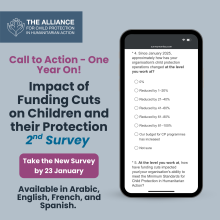
New Survey: How Are Funding Cuts Affecting Children’s Protection?
Poster
One year after major global funding reductions, the Alliance is gathering updated evidence on how these ongoing cuts and humanitarian system changes are affecting children and child protection services. The survey takes 15–20 minutes, is anonymous, and is designed to capture experiences across levels— especially practitioners working at country and sub-national levels. Take the survey in English...

New Briefing Note! Global Impact of Humanitarian Funding Cuts on Children’s Protection

Poster
Drawing on input from over 250 child protection practitioners in 55 countries, and insights from five leading child protection agencies, this new brief on the "Global Impact of Humanitarian Funding Cuts on Children and Their Protection in Humanitarian Contexts" presents stark evidence of the catastrophic consequences that ongoing funding cuts are having on children’s safety and well-being...

Key Tools

Brief | Global Impact of Funding Cuts on Children and their Protection in Humanitarian Contexts

Cover

Children have the right to be protected from abuse, neglect, exploitation, and violence. Yet, in humanitarian crises children suffer first and most, with devastating consequences for their immediate safety and long-term well-being. The humanitarian system is under unprecedented strain. Major donors, including the US and key European governments, have drastically reduced humanitarian funding or

Guidance Note | Resources for Conducting Ethical Research with Children in Humanitarian Contexts

Cover

This Resource List catalogues critical resources to guide ethical good practices in participatory research with children in humanitarian contexts. It is not an exhaustive compilation, nor does it propose new ethical guidelines. Instead, it highlights existing tools that help researchers and practitioners understand, utilise, and apply well-established ethical principles. 

These resources are

Enhanced CPMS Indicators Table

Enhanced CPMS Indicators Table

An easy-to-navigate PDF, the Enhanced CPMS Indicators Table includes the 28 Child Protection Minimum Standards and their indicators with type, target values and explanatory notes plus suggested computation methods and data source examples. Developed by the Assessment, Measurement and Evidence Working Group, this tool is part of the measurement framework of the CPMS 2019 edition.

Resources

Child Protection Rapid Assessment (CPRA) Toolkit Review

This report provides findings and analysis on the use of the Child Protection Rapid Assessment (CPRA) Toolkit between 2014 and 2018. It includes recommendations for (a) improving the CPRA Toolkit and (b) more effectively situating it within the broader framework of child protection analysis and assessment in humanitarian contexts. This is the second review of the CPRA toolkit and builds upon the...

Briefing Note | Setting the Global Research Agenda for Child Protection in Humanitarian Contexts

 cover_9
At the end of 2017, the Assessment, Measurement and Evidence (AME) Working Group of the Alliance for Child Protection in Humanitarian Action undertook a research prioritization exercise, adapted from the Child Health and Nutrition Research Initiative (CHNRI), to identify and rank research priorities for child protection in emergencies. Forty-nine child protection experts working in a range of...

Site Specific Child Protection Rapid Assessment: A guidance note

This guidance note is an addendum to the Child Protection Rapid Assessment (CPRA) toolkit produced by the Child Protection Working Group. It should be used in conjunction with the CPRA toolkit in situations where: The number of distinct communities affected by the emergency is smaller than 15, or Less than 15 of the affected communities are accessible for the purpose of the assessment. The...

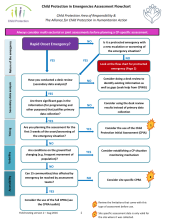
Child Protection in Emergencies Assessment Flowchart

Cover
This flowchart is designed to help determine the type of assessment needed in a given humanitarian context.

Child Protection in Emergencies Initial Assessment (CPIA)
Cover
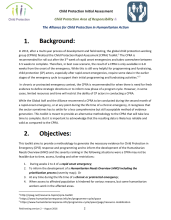
This toolkit aims to provide a methodology to generate the necessary evidence for Child Protection in Emergency (CPiE) response and programming and to inform the development of the Humanitarian Needs Overview (HNO) and the severity ranking in the following situations were a CPRA may not be feasible due to time, access, funding and other restrictions: During weeks 2 to 4 of a rapid onset emergency...

Webinars

Webinar | Enhancing Parenting Practices in Humanitarian Settings: Evidence and Strategies

Poster
Discover how parenting interventions can transform lives in humanitarian crises. Our expert panel will discuss the findings of a comprehensive meta-analysis on reducing violence against children and improving family well-being in low- and middle-income countries. What You'll Learn: Key findings on the effectiveness of parenting interventions. Challenges and strategies for implementation in crisis...

Webinar | Harnessing AI and Secondary Data for Smarter Child Protection in Humanitarian Contexts

Poster
In the second instalment of the Empowering Child Protection through Evidence Webinar Series, presented by the Alliance, the CPAoR, and UNHCR, this webinar will feature case studies demonstrating how child protection actors can use data and evidence to inform their response, monitoring, and planning in humanitarian contexts. In today’s increasingly complex crises and with the abundance of data...

Webinar | Strategic Advocacy and Funding in CPHA: Leveraging Data and Evidence for Success

Poster
This webinar, hosted by the Advocacy Working Group and Assessment Measurement and Evidence Working Group, will delve into the crucial role of data and evidence in shaping advocacy strategies for child protection in humanitarian action (CPHA) and in securing funding. Through case studies and expert insights, the webinar will highlight successful examples where evidence and data have been used to...

Webinar | Capturing Voices: Evidence Generation for CAAFAG

Poster
Watch the recording in French or Spanish ! The involvement of children associated with armed forces and armed groups (CAAFAG) in evidence generation, including data collection for research and learning, is often methodologically and ethically challenging. While it is understandable that field practitioners may be hesitant to involve CAAFAG in knowledge generation activities due to the risks and...

Assessment, Measurement, and Evidence Working Group Lead's

Amon Lungu, World Vision

Camilla Fabbri, International Rescue Committee