

L'Alliance s'engage à élaborer des normes et des documents couvrant tous les domaines liés à la protection de l'enfance dans l'action humanitaire et à produire des lignes directrices à destination des acteurs humanitaires. L'Alliance est également la dépositaire des Standards minimums pour la protection de l'enfance dans l'action humanitaire, qui sont considérés comme un complément aux Standards Sphère.
Search
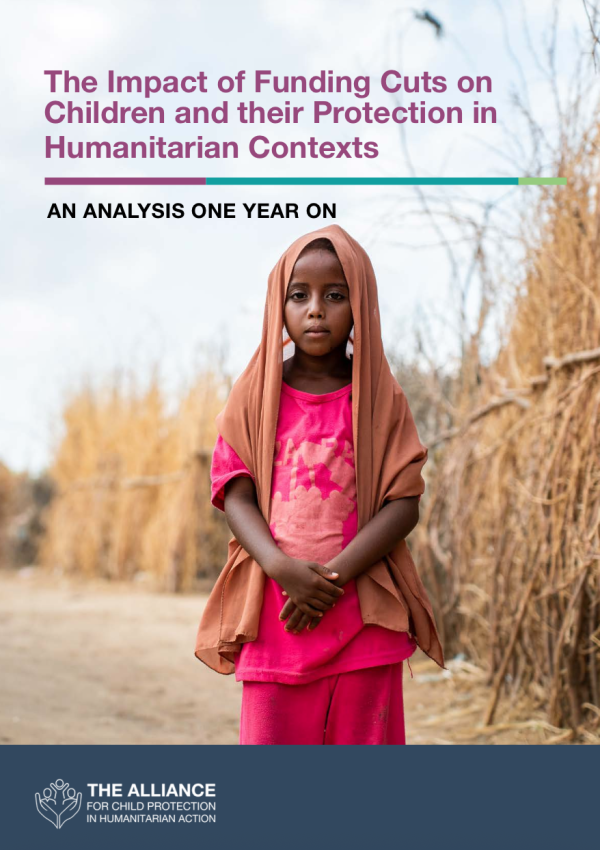
The Impact of Funding Cuts on Children and their Protection in Humanitarian Contexts: An Analysis One Year On
This global brief examines how sustained humanitarian funding cuts since early 2025 are affecting children’s safety, access to protection services, and the overall capacity of child protection systems across humanitarian contexts. Drawing on insights from 401 practitioners across 68 countries...
Reflection | The Alliance's Participation at the Sixth Global Conference on the Elimination of Child Labour
The Alliance for Child Protection in Humanitarian Action was pleased to participate in the 6th Global Conference on the Elimination of Child Labour from February 11th - 13th in Marrakesh, contributing expertise on specialised child protection prevention and response services, and on multisectoral...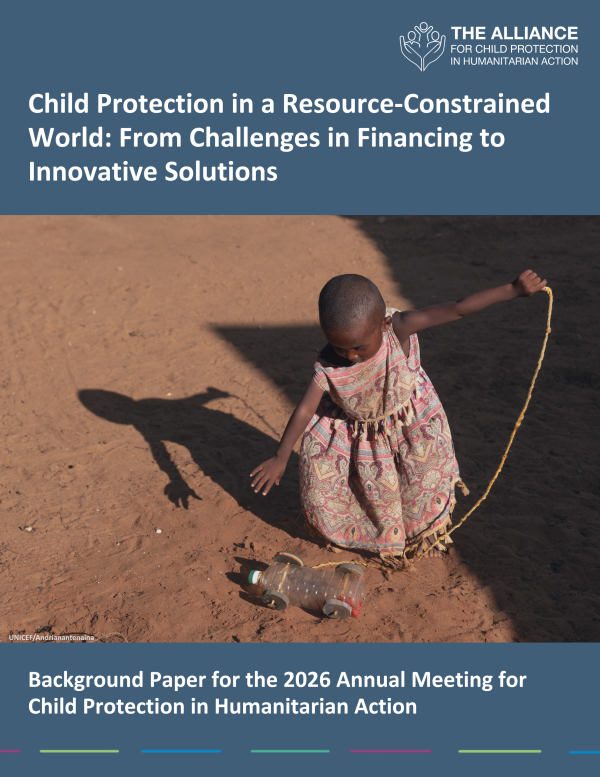
Background Paper | Child Protection in a Resource-Constrained World: From Challenges in Financing to Innovative Solutions
This background paper sets the scene for the 2026 Annual Meeting for Child Protection in Humanitarian Action, examining how escalating humanitarian needs, acute funding cuts, system-wide reforms, and the erosion of international humanitarian and human rights law are reshaping the operating...
2023-2024 Annual Report | The Alliance for Child Protection in Humanitarian Action
The Alliance for Child Protection in Humanitarian Action (the Alliance) is a global network that facilitates inter-agency technical collaboration on child protection in all humanitarian contexts. This 2023-2024 Annual Report provides a summary of the Alliance’s activities and accomplishments guided...
One Year On from the First Ministerial Conference to End Violence Against Children: A Call to Strengthen Commitment to Children Affected by Conflict and Crisis
It’s been one year since the first Global Ministerial Conference to End Violence Against Children, held in Bogotá in 2024 — a milestone moment that united governments and partners around a shared vision: A world where every child grows up safe and free from violence. Since then, there’s been...
Case Management Forms Video Series
Appropriate documentation by caseworkers is essential for effective and accountable child protection case management. The Case Management Forms — updated in 2024 — support consistent, ethical, and informed practice across humanitarian contexts. Each short video in this playlist explains the purpose...
Inter-agency Guidance on Child Protection Case Management Data Categorisation
Watch the Global Launch of the Guidance on Child Protection Case Management Data Categorisation here . Child Protection Case Management (CPCM) is a cornerstone of child protection in humanitarian settings. While numerous tools and guidelines exist, there is an opportunity to utilise CPCM data more...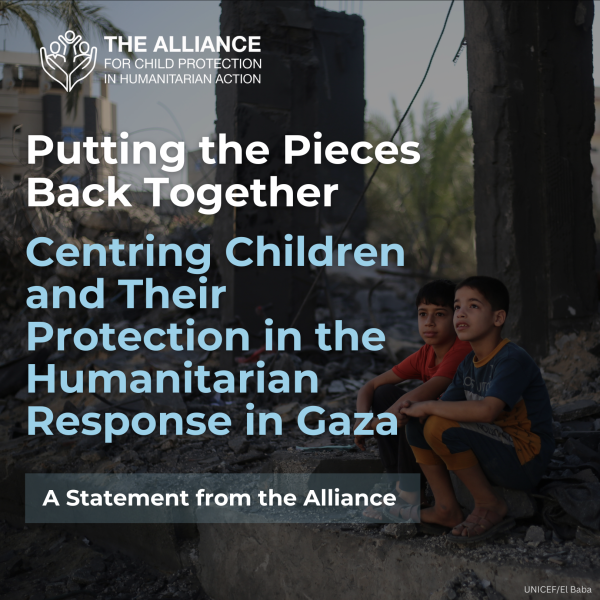
Putting the Pieces Back Together: Centring Children and Their Protection in the Humanitarian Response in Gaza
With the ceasefire in Gaza and the scale-up of humanitarian assistance, the Alliance for Child Protection in Humanitarian Action calls for children’s protection to be placed at the centre of the response. This statement outlines urgent priorities to meet the needs of Gaza’s 1.1 million children —...
Report | CPHA Practitioners Survey - Capacity and Learning Needs
The Alliance for Child Protection in Humanitarian Action (The Alliance), the Global Child Protection Area of Responsibility (CP AoR), and UN Refugee Agency (UNHCR) conducted a joint survey on Capacities and Learning Needs in Child Protection in Humanitarian Action from May to August 2024. This joint...
Briefing Note: The Impact of UN80, the Humanitarian Reset, and Funding Cuts on the Children and Armed Conflict (CAAC) Agenda
This note outlines how ongoing reforms, in particular the Humanitarian Reset and UN80 Initiative, underpinned by deepening funding cuts, risk undermining the Children and Armed Conflict (CAAC) agenda. It provides recommendations to ensure that critical gains that have been made to address the...
Children Associated with Armed Forces and Armed Groups Task Force - Offer of Support
This Offer of Support outlines how the Children Associated with Armed Forces and Armed Groups (CAAFAG) Task Force coordinates humanitarian and development actors to strengthen quality programming that prevents recruitment, facilitates release, and responds to the needs of CAAFAG in emergencies and...
Joint Statement on the International Day to Protect Education from Attack
On the International Day to Protect Education from Attack, the Inter-agency for Education in Emergencies and the Alliance for Child Protection in Humanitarian Action jointly condemn all forms of attacks on education and call for all parties to conflict to respect international humanitarian law, to...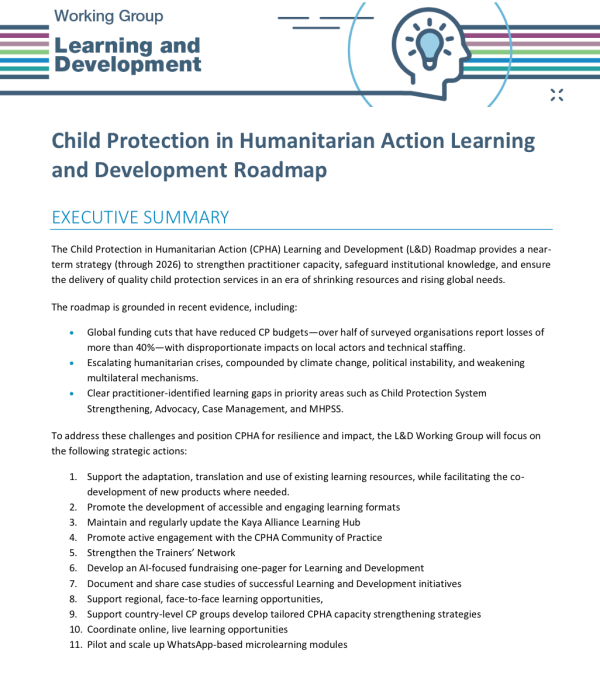
Child Protection in Humanitarian Action Learning and Development Roadmap
The Child Protection in Humanitarian Action (CPHA) Learning and Development (L&D) Roadmap provides a near-term strategy (through 2026) to strengthen practitioner capacity, safeguard institutional knowledge, and ensurethe delivery of quality child protection services in an era of shrinking resources...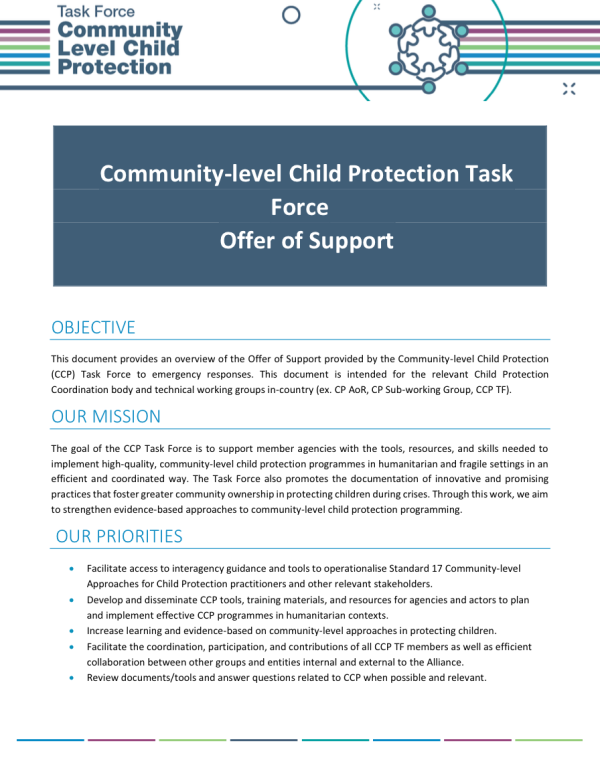
Community-level Child Protection Task Force - Offer of Support
This Offer of Support outlines how the Community-level Child Protection (CCP) Task Force supports member agencies by providing the tools, resources, and skills needed to implement high-quality, community-level child protection programmes in humanitarian and fragile settings in an efficient and...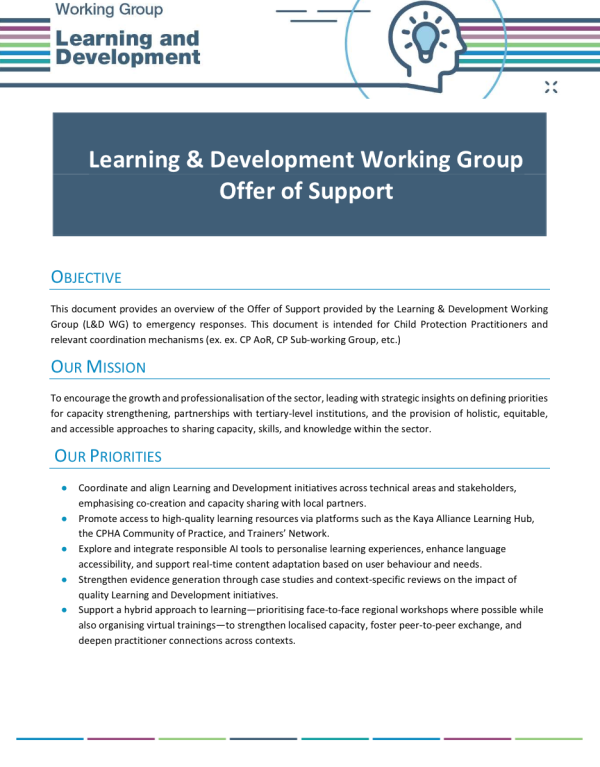
Learning & Development Working Group - Offer of Support
This Offer of Support outlines how the Learning & Development (L&D) Working Group encourages the growth and professionalisation of the sector, leading with strategic insights on defining priorities for capacity strengthening, partnerships with tertiary-level institutions, and the provision of...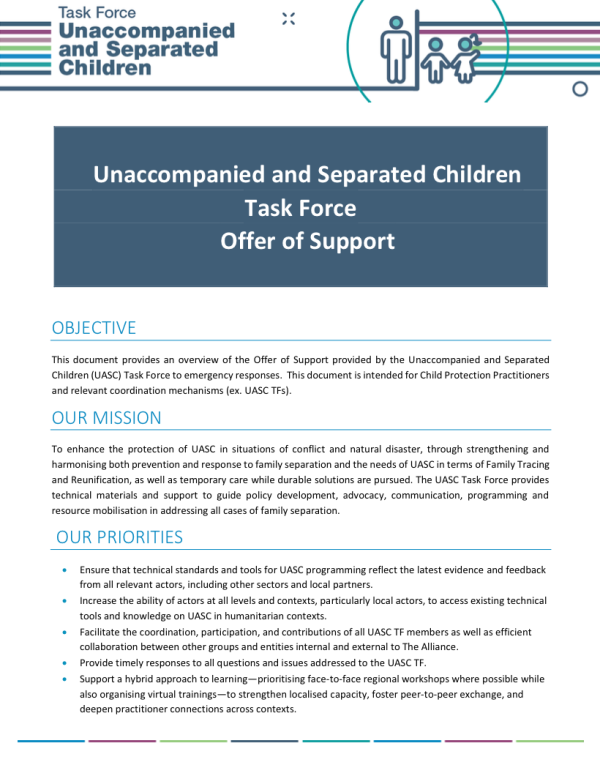
The Unaccompanied and Separated Children Task Force - Offer of Support
This Offer of Support outlines how the Unaccompanied and Separated (UASC) Children Task Force provides technical materials and support to guide policy development, advocacy, communication, programming, and resource mobilisation in addressing all cases of family separation. It highlights the UASC...
Report | An Overview of the 2025 Annual Meeting for Child Protection in Humanitarian Action
From the 3rd to the 5th of June, 841 participants from across the globe—including practitioners, donors, academics, policymakers, youth and child advocates, and community leaders—came together for the 2025 Annual Meeting for Child Protection in Humanitarian Action, hosted by the Alliance for Child...
Blog Series | 2025 Annual Meeting for Child Protection in Humanitarian Action
The 2025 Annual Meeting of the Alliance for Child Protection in Humanitarian Action convened more than 800 participants around a vital theme: Protection of Children from the Ground Up – Enhancing Localised Approaches in Conflict and Crises. At a time when conflicts are intensifying, funding is...
Strategic Brief | Prioritising Protection of Children in a Changing Humanitarian Landscape
This Strategic Brief outlines how the Alliance for Child Protection in Humanitarian Action (the Alliance) will support the sector in mitigating the impact of reduced resources and structural shifts in the humanitarian system. It focusses on sustaining the ability of humanitarian actors to deliver...
Primary Prevention Framework for Child Protection in Humanitarian Action, Revised Edition - 2024
Child Protection in Humanitarian Action (CPHA) is “the prevention of and response to abuse, neglect, exploitation and violence against children in humanitarian action.” While significant effort and improvements have been made in the sector on responding when harm has already taken place, less focus...
Report | Alternative Care Survey
Children affected by armed conflict, displacement, and natural disasters are at greater risk of being separated from their families, leading to increased vulnerability. Strengthening alternative care systems is critical to ensuring their protection, development and wellbeing. Since 2013, the...
Child Protection Minimum Standards Accountability to Children Toolkit
Since their launch in 2012, a broad range of humanitarian actors now work with the Minimum Standards for Child Protection in Humanitarian Action (the CPMS) to better protect children facing violence, abuse, exploitation or neglect in emergencies around the world. Through the CPMS and our 10 sector...
The Alliance Flyer (2025)
This flyer provides a brief overview of the structure and activities of the Alliance for Child Protection in Humanitarian Action (the Alliance) in 2025.
Analytical Report | Review of Child Protection Case Management Data
This Analytical Report presents the findings of child protection case management data extracted from the Child Protection Information Management System (CPIMS+) in six humanitarian settings: Bangladesh, Kenya, Lebanon, Myanmar, Nigeria, and Ukraine. Conducted by UNICEF with support from the US...