
Children Who are at Risk of Their Protection Rights Being Violated (CPMS)
Protection risks of children, their families, and their communities are exponentially compounded and increased during crises. Understanding historical and crisis-specific vulnerabilities and disparities in services allows both sectors to approach planning, interventions, and policy-making from a more informed perspective. As both sectors explore programmatic interventions, consider the following questions:
- How do these specific circumstances and experiences of each high-risk population impact a child’s ability to safely and fully access and participate in learning?
- What are the specific barriers or challenges that prevent or limit access and participation?
- Are existing learning interventions able to accommodate children’s specific protection and learning needs with no, little, or substantial additional inputs? What inputs are required?
- Are government policies and school cultures/infrastructure welcoming, explicitly mitigate protection risks, and foster equity now and for the future?
This Tip Sheet offers interventions, guiding questions and an example of how 4 Key Gender Equality Measures (GEMs) support gender equality in Education projects and programs. It should be read together with the GAM Overview. The IASC GAM identifies and codes projects based on the extent to which key...
Gender disparities in education persist in many low‐ and middle‐income countries. A clear understanding of the most effective approaches to improving education outcomes for girls, and to narrowing gender gaps, is largely missing from literature and practice. This review looks at whether...
The INEE Gender Training Manual is intended to orient education practitioners to the INEE Guidance Note on Gender: Gender Equality in and through Education (2019). This training manual outlines 4-8 hours of training activities and materials related to gender-responsive education in emergencies...
The INEE Guidance Note on Gender, an update to the 2010 Gender Pocket Guide, provides guidance on delivering education in a gender-responsive manner to anyone involved in providing education in emergencies (EiE) as part of an emergency preparedness, response, or recovery situation. This includes...
The Inclusive Distance Education Toolkit compiles resources on: inclusive education, education in emergencies, disability inclusive education, and distance education across the humanitarian-development nexus.The resources aim to support practitioners to create and implement inclusive-distance...
The Inclusive Education Resources and Toolkit is a resource and reference for all staff working in education programming to mainstream inclusion in their work. The Toolkit provides recommendations and resources to strengthen inclusive education programming to enable Save the Children to achieve...
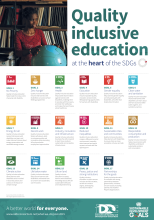
This resource highlights the central role of quality inclusive education in achieving the Sustainable Development Goals (SDGs). It outlines how inclusive education for learners with disabilities contributes to ending poverty, promoting health and wellbeing, reducing inequalities, fostering...
This factsheet draws on study carried out by Humanity & Inclusion (HI) with the support of the AFD (Agence Française de Développement) and Norad (Norwegian Agency for Development Cooperation) as part of our regional inclusive education projects. The objectives of this study, entitled “Les...
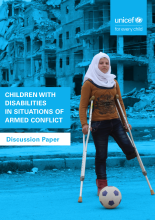
Over the last four years, the number of UNICEF Country Offices supporting children with disabilities in emergency contexts has increased more than five-fold with programmes including accessible child-friendly spaces in Jordan, targeted cash transfer programmes in Syria, and accessible items in our...

This unit will explore Learning Through Play in Emergencies in more depth, looking at what it is, why we should do it, how to implement it, and the enabling systems needed to effectively do so.This course unit is primarily designed for education in emergencies (EiE) or education practitioners to...
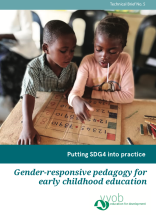
Tackling gender bias and stereotypes early on is fundamental to address gender inequalities that manifest later in life. Early childhood education (ECE) teachers are in a unique position to challenge and limit the maturation of these gender stereotypes. Gender-Responsive Pedagogy for Early Childhood...
This thematic brief sheds light on the need to better ensure children in humanitarian settings receive nurturing care. The brief summarises what programme planners and implementers can do to minimise the impact that emergencies have on the lives of young children and their families.
Building on existing work, the ECD Programme Guidance does the following: Provides a framework for articulating a vision, corresponding goals and indicators linked to the commitments made for ECD within the Sustainable Development Goals (SDGs) and the Strategic Plan (SP) (2018-2021); Identifies...
This manual provides guidance on how to assess need, design, and implement Early Childhood Development in Emergencies (ECDiE), supporting each of the four core components of a response: early learning and stimulating environments, positive child-caregiver interaction, protective environments, and...
In humanitarian response, practitioners often use humanitarian standards and sector-specific guidelines to standardize the planning, implementation, and evaluation of programming. While there have been some analysis of humanitarian standards and guidance,2 to our knowledge there has been no...
This review provides an overview of the evidence base on learning outcomes for adolescents in contexts of fragility, crisis and emergencies – with a focus on adolescent girls and adolescents with disabilities (AwD). While the evidence base at the secondary level is relatively small, effective...
The Global Education Cluster (GEC) has been working to build the evidence base around cash and voucher assistance (CVA) in education in emergencies (EiE), resulting in the publication of the “Cash and Voucher Assistance for Education in Emergencies Synthesis Report and Guidelines” in 2019. This...

The ‘Education interventions for CAAFAG’ Technical Note is based upon an extensive desk study, key informant inter- views with 23 practitioners from a range of roles, including in Child Protection and Education, as well as technical in- put from the CAAFAG Task Force and CAAFAG Education technical...

The Family Strengthening Task Force is pleased to present this Compendium of Family and Caregiver Strengthening Interventions and Tools!
As defined in the Minimum Standards for Child Protection in Humanitarian Action (2019), family and caregiving strengthening aims to promote children’s healthy...

Children with disabilities are particularly vulnerable in humanitarian settings, yet they are often not able to access the services and protection they need. While multiple factors create these barriers, a major cause is how data about children with disabilities is collected and mapped. Data...

In humanitarian situations, the risks of children being out of school and engaging in child labour are both significantly elevated, particularly for displaced, refugee, and migrant children. Hence, while education is critical for the successful prevention of and response to child labour in...

In 2021, the Alliance for Child Protection in Humanitarian Action published the Primary Prevention Framework for Child Protection in Humanitarian Action (the Framework). This was developed due to the recognition that whilst there has been significant progress regarding response to harm against...

The primary objective of the BIP Guidelines is to support UNHCR and partner staff in improving the protection outcomes for refugee children by: situating the best interests of refugee children within a comprehensive child protection system and...

The Alternative Care in Emergencies (ACE) Toolkit is designed to facilitate interagency planning and implementation of alternative care and related services for children separated from or unable to live with their families during and after an emergency. There is no single type of care placement that...

The CAAFAG Task Force was pleased to contributed to the Mental Health and Psychosocial Support in CAAFAG Programmes Learning Package. The MHPSS in CAAFAG Programmes Resource Package (field-test version) is an inter-agency package of resources that aims to support the integration of MHPSS into...

The Unaccompanied and Separated Children (UASC) Field Handbook is a product of the Inter-agency Working Group on Unaccompanied and Separated Children (IAWG UASC). It was produced in conjunction with the Unaccompanied and Separated Children Toolkit, 2017.
In 2004, the Inter-agency Guiding Principles...

This report suggests that the number of child-victims and the number of children in conflict with the law rise significantly during all types of emergencies. According to practitioners, conflict and civil unrest negatively impact justice for children more than natural disasters. Strengthening...

The Unaccompanied and Separated Children (UASC) Toolkit is a product of the Inter-agency Working Group on Unaccompanied and Separated Children (IAWG UASC). It was produced in conjunction with the Unaccompanied and Separated Children (UASC) Field Handbook, 2016.
In 2004, the Inter-agency Guiding...

This video provides an overview of Standard 8: Physical Violence and Other Harmful Practices of the CPMS (Child Protection Minimum Standards in Humanitarian Action). When using these videos, we strongly recommend you refer to the Facilitator’s Notes.
For the rest of the CPMS video series, click he...

This Technical Note provides information on the challenges that girls associated with armed forces and armed groups (GAAFAG) face during their recruitment, their period of association, and their reintegration, as well as lessons learnt and promising practices to implement gender-sensitive and gender...
- 1184 views