
Children Who are at Risk of Their Protection Rights Being Violated (CPMS)
Protection risks of children, their families, and their communities are exponentially compounded and increased during crises. Understanding historical and crisis-specific vulnerabilities and disparities in services allows both sectors to approach planning, interventions, and policy-making from a more informed perspective. As both sectors explore programmatic interventions, consider the following questions:
- How do these specific circumstances and experiences of each high-risk population impact a child’s ability to safely and fully access and participate in learning?
- What are the specific barriers or challenges that prevent or limit access and participation?
- Are existing learning interventions able to accommodate children’s specific protection and learning needs with no, little, or substantial additional inputs? What inputs are required?
- Are government policies and school cultures/infrastructure welcoming, explicitly mitigate protection risks, and foster equity now and for the future?
Protection risks of children, their families, and their communities are exponentially compounded and increased during crises. Understanding historical and crisis-specific vulnerabilities and disparities in services allows both sectors to approach planning, interventions, and policy-making from a...
In emergency and protracted crisis settings, there is a significant education gap for out-of-school youth. This NORCAP study focuses on the lack of educational opportunities for them.Research revealed primary education as the predominant Education in Emergencies (EiE) priority, as well as an absence...
These IASC guidelines provide a framework for working with and for young people throughout the humanitarian programme cycle (HPC), complete with tips, examples and case studies. In addition, humanitarian actors can use this guidance as a reference to design programmes that respond to their context.
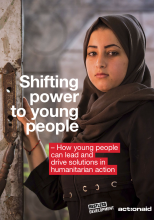
Shifting Power to Young People: How Young People Can Lead and Drive Solutions in Humanitarian Action
Engaging young people in humanitarian action is however not a matter of if but how. Through interaction with close to 400 young people across 54 countries, this report concludes that young people, and particularly young women, are severely affected by emergencies and protracted crises – and are key...
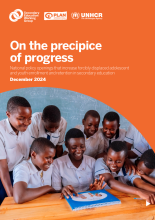
This publication presents examples of policy ‘openings’ in four settings where different forcibly displaced population types are included in national education systems in different ways. For a balanced evaluation of progress in Colombia, Iraq, Nigeria, and Rwanda, policy objectives are held in...
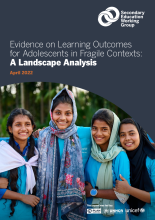
This review provides an overview of the evidence base on learning outcomes for adolescents in contexts of fragility, crisis and emergencies – with a focus on adolescent girls and adolescents with disabilities (AwD). While the evidence base at the secondary level is relatively small, effective...
- 1184 views