
Children Who are at Risk of Their Protection Rights Being Violated (CPMS)
Protection risks of children, their families, and their communities are exponentially compounded and increased during crises. Understanding historical and crisis-specific vulnerabilities and disparities in services allows both sectors to approach planning, interventions, and policy-making from a more informed perspective. As both sectors explore programmatic interventions, consider the following questions:
- How do these specific circumstances and experiences of each high-risk population impact a child’s ability to safely and fully access and participate in learning?
- What are the specific barriers or challenges that prevent or limit access and participation?
- Are existing learning interventions able to accommodate children’s specific protection and learning needs with no, little, or substantial additional inputs? What inputs are required?
- Are government policies and school cultures/infrastructure welcoming, explicitly mitigate protection risks, and foster equity now and for the future?
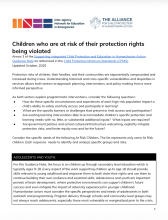
Protection risks of children, their families, and their communities are exponentially compounded and increased during crises. Understanding historical and crisis-specific vulnerabilities and disparities in services allows both sectors to approach planning, interventions, and policy-making from a...

This unit will explore Learning Through Play in Emergencies in more depth, looking at what it is, why we should do it, how to implement it, and the enabling systems needed to effectively do so.This course unit is primarily designed for education in emergencies (EiE) or education practitioners to...
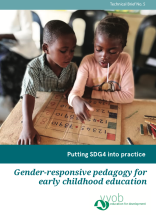
Tackling gender bias and stereotypes early on is fundamental to address gender inequalities that manifest later in life. Early childhood education (ECE) teachers are in a unique position to challenge and limit the maturation of these gender stereotypes. Gender-Responsive Pedagogy for Early Childhood...
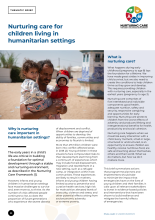
This thematic brief sheds light on the need to better ensure children in humanitarian settings receive nurturing care. The brief summarises what programme planners and implementers can do to minimise the impact that emergencies have on the lives of young children and their families.
Building on existing work, the ECD Programme Guidance does the following: Provides a framework for articulating a vision, corresponding goals and indicators linked to the commitments made for ECD within the Sustainable Development Goals (SDGs) and the Strategic Plan (SP) (2018-2021); Identifies...
This manual provides guidance on how to assess need, design, and implement Early Childhood Development in Emergencies (ECDiE), supporting each of the four core components of a response: early learning and stimulating environments, positive child-caregiver interaction, protective environments, and...
In humanitarian response, practitioners often use humanitarian standards and sector-specific guidelines to standardize the planning, implementation, and evaluation of programming. While there have been some analysis of humanitarian standards and guidance,2 to our knowledge there has been no...

The Family Strengthening Task Force is pleased to present this Compendium of Family and Caregiver Strengthening Interventions and Tools!
As defined in the Minimum Standards for Child Protection in Humanitarian Action (2019), family and caregiving strengthening aims to promote children’s healthy...
- 1184 views