
Children Who are at Risk of Their Protection Rights Being Violated (CPMS)
Protection risks of children, their families, and their communities are exponentially compounded and increased during crises. Understanding historical and crisis-specific vulnerabilities and disparities in services allows both sectors to approach planning, interventions, and policy-making from a more informed perspective. As both sectors explore programmatic interventions, consider the following questions:
- How do these specific circumstances and experiences of each high-risk population impact a child’s ability to safely and fully access and participate in learning?
- What are the specific barriers or challenges that prevent or limit access and participation?
- Are existing learning interventions able to accommodate children’s specific protection and learning needs with no, little, or substantial additional inputs? What inputs are required?
- Are government policies and school cultures/infrastructure welcoming, explicitly mitigate protection risks, and foster equity now and for the future?
Protection risks of children, their families, and their communities are exponentially compounded and increased during crises. Understanding historical and crisis-specific vulnerabilities and disparities in services allows both sectors to approach planning, interventions, and policy-making from a...
The INEE Inclusive Education in Emergencies Training Module introduces participants to basic concepts of inclusive education in emergencies. This updated version builds on the 2011 Education in Emergencies Harmonized Training Package module and aligns with content in the Disability-inclusive...
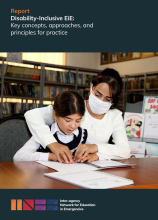
Disability-inclusive Education in Emergencies: Key Concepts, Approaches, and Principles for Practice
This report defines and clarifies key concepts and terminology for disability-inclusive education in emergencies (EiE) and provides seven guiding principles. It is meant to be used as a companion piece to the INEE Minimum Standards and to support stakeholders’ efforts to be more intentional in their...
The Inclusive Distance Education Toolkit compiles resources on: inclusive education, education in emergencies, disability inclusive education, and distance education across the humanitarian-development nexus.The resources aim to support practitioners to create and implement inclusive-distance...
The Inclusive Education Resources and Toolkit is a resource and reference for all staff working in education programming to mainstream inclusion in their work. The Toolkit provides recommendations and resources to strengthen inclusive education programming to enable Save the Children to achieve...
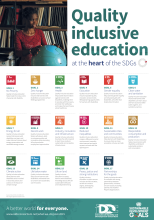
This resource highlights the central role of quality inclusive education in achieving the Sustainable Development Goals (SDGs). It outlines how inclusive education for learners with disabilities contributes to ending poverty, promoting health and wellbeing, reducing inequalities, fostering...
This factsheet draws on study carried out by Humanity & Inclusion (HI) with the support of the AFD (Agence Française de Développement) and Norad (Norwegian Agency for Development Cooperation) as part of our regional inclusive education projects. The objectives of this study, entitled “Les...
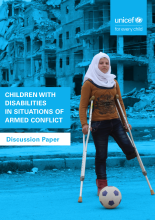
Over the last four years, the number of UNICEF Country Offices supporting children with disabilities in emergency contexts has increased more than five-fold with programmes including accessible child-friendly spaces in Jordan, targeted cash transfer programmes in Syria, and accessible items in our...
The Global Education Cluster (GEC) has been working to build the evidence base around cash and voucher assistance (CVA) in education in emergencies (EiE), resulting in the publication of the “Cash and Voucher Assistance for Education in Emergencies Synthesis Report and Guidelines” in 2019. This...

Children with disabilities are particularly vulnerable in humanitarian settings, yet they are often not able to access the services and protection they need. While multiple factors create these barriers, a major cause is how data about children with disabilities is collected and mapped. Data...
- 1184 views