
Children Who are at Risk of Their Protection Rights Being Violated (CPMS)
Protection risks of children, their families, and their communities are exponentially compounded and increased during crises. Understanding historical and crisis-specific vulnerabilities and disparities in services allows both sectors to approach planning, interventions, and policy-making from a more informed perspective. As both sectors explore programmatic interventions, consider the following questions:
- How do these specific circumstances and experiences of each high-risk population impact a child’s ability to safely and fully access and participate in learning?
- What are the specific barriers or challenges that prevent or limit access and participation?
- Are existing learning interventions able to accommodate children’s specific protection and learning needs with no, little, or substantial additional inputs? What inputs are required?
- Are government policies and school cultures/infrastructure welcoming, explicitly mitigate protection risks, and foster equity now and for the future?
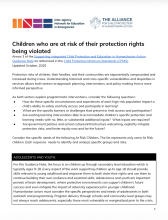
Protection risks of children, their families, and their communities are exponentially compounded and increased during crises. Understanding historical and crisis-specific vulnerabilities and disparities in services allows both sectors to approach planning, interventions, and policy-making from a...
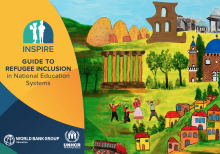
The INSPIRE Guide is intended as a resource for practitioners working on the inclusion of refugee children in national education systems. The Guide has three sections. Section I, the Guidance Note, is designed as a primer to provide clear, concise, and practical information on policy and process...
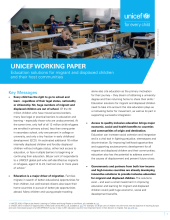
This UNICEF working paper discusses education solutions for migrant and displaced children and their host communities.
The Global Compact on Refugees is a framework for more predictable and equitable responsibility-sharing, recognizing that a sustainable solution to refugee situations cannot be achieved without international cooperation.It provides a blueprint for governments, international organizations, and other...
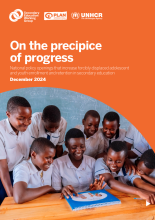
This publication presents examples of policy ‘openings’ in four settings where different forcibly displaced population types are included in national education systems in different ways. For a balanced evaluation of progress in Colombia, Iraq, Nigeria, and Rwanda, policy objectives are held in...
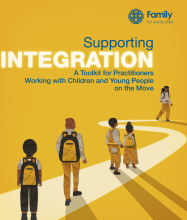
In 2020, 36 million children were living outside of their country of birth. About one third of these children were refugees and asylum seekers.No matter where children and young people are in their migration journey- whether in transit or at destination- it is vital that their sense of belonging and...
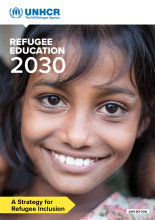
Refugee Education 2030: A Strategy for Refugee Inclusion aims to contribute directly to the following goals of the Global Compact on Refugees: Ease the pressures on host countriesEnhance refugee self-relianceSupport conditions in countries of origin for return in safety and dignityThe strategy...
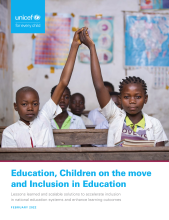
Today, the world is facing compounding humanitarian, environmental and economic crises that have spurred the migration and displacement of millions of children and their families. The number of internally displaced children, refugees, migrants, and asylum seekers and in some cases, returnees, has...
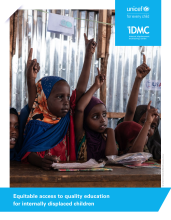
The exact number of children living in internal displacement worldwide is unknown, but there were estimated to be over 17 million at the end of 2018, as a result of conflict and violence, and millions more due to disasters. Five million youth, aged between 18 and 24, were also living in internal...

The primary objective of the BIP Guidelines is to support UNHCR and partner staff in improving the protection outcomes for refugee children by: situating the best interests of refugee children within a comprehensive child protection system and...

The Unaccompanied and Separated Children (UASC) Field Handbook is a product of the Inter-agency Working Group on Unaccompanied and Separated Children (IAWG UASC). It was produced in conjunction with the Unaccompanied and Separated Children Toolkit, 2017.
In 2004, the Inter-agency Guiding Principles...

The Unaccompanied and Separated Children (UASC) Toolkit is a product of the Inter-agency Working Group on Unaccompanied and Separated Children (IAWG UASC). It was produced in conjunction with the Unaccompanied and Separated Children (UASC) Field Handbook, 2016.
In 2004, the Inter-agency Guiding...
- 1184 views