
Foundational Areas of Work

Across humanitarian action, there are established best practices to ensure programs are context-specific, culturally responsive, effective, and efficient. Much of that is related to the process stakeholders take to determine the most effective and responsive programming, build relationships and work in a coordinated way with others to support families, schools / learning environments, and communities. Those practices and programming evolve as the context and needs of communities change across the life of a response. 

The protection of affected populations and provisions of basic services are the responsibilities of a country’s government. Education and Protection Clusters/coordination mechanisms must consider how their activities strengthen and support the government’s immediate and long-term response abilities.
 Cover
Children, as an evidence-based resource for governments, international agencies, non-governmental organizations and individuals committed to preventing and responding to violence against children. Ten core agencies collaborated on its development, including the World Health Organization (WHO)...
 Cover
The purpose of this toolkit is to support the design and implementation of M&E Frameworks for specific accelerated education programmes in order to support learning and accountability.The toolkit consists of a user manual plus five tools in a single Excel document (Annex 4) which are all editable...
Cover
Delivering effective education, especially in low-resourced settings, is hard. The fact that nine out of ten children in low-income countries cannot read by age 10 is a testament to this challenge. Adding to these difficulties is the reality that many, if not most, international education...
Cover
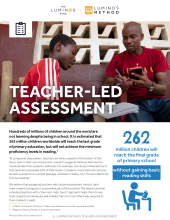
Hundreds of millions of children around the world are not learning despite being in school. It is estimated that 262 million children worldwide will reach the last grade of primary education but will not achieve the minimum proficiency levels in reading. To compound the problem, teachers are often...
Cover
USAID Education in Crisis and Conflict Network (ECCN) has developed a Safer Learning Environments (SLE) Assessment Toolkit. Three previous drafts of the toolkit have been piloted by teams in nine countries and the final version is ready to use. This version is a significant revision to the SLE...
Cover
The purpose of the toolkit is to provide guidance on how to develop and implement systems for monitoring child protection issues that affect children in humanitarian settings, as well as for monitoring the child protection response. Acknowledging the multifaceted nature of protection, this toolkit...
Cover
This document outlines some potential safeguarding risks of monitoring, evaluation, accountability, and learning (MEAL) and research activities, and provides suggestions of how to manage these activities so that they are as safe for affected children and adults as possible.This is guidance for Save...
Cover
The Measurement Library is a collection of measurement tools to assess children’s learning and holistic development and service provider quality in crisis contexts. The tools are meant to help education practitioners generate high-quality data to inform program planning and review.
Enhanced CPMS Indicators Table
An easy-to-navigate PDF, the Enhanced CPMS Indicators Table includes the 28 Child Protection Minimum Standards and their indicators with type, target values and explanatory notes plus suggested computation methods and data source examples. Developed by the Assessment, Measurement and Evidence...