

Evaluar, medir y generar evidencia

Dirigido por: World Vision International y la UNICEF Innocenti - Oficina Mundial de Investigación y Prospectiva

Ponte en contacto con nosotros: ame.wg@alliancecpha.org

Nuestra misión

El grupo de trabajo para la evaluación, medición y evidencia se estableció para equipar a los profesionales de protección de la niñez con herramientas, información comprobada y capacidad técnica que se requieren para mejorar los resultados de la niñez en contextos humanitarios. Nos enfocamos en promover toma de decisiones que estén basadas en información corroborada, fomentar la colaboración y desarrollar capacidades en cómo integrar datos y perspectivas a la hora de diseñar y ejecutar programas.

Prioridades del grupo de trabajo para evaluar, medir y comprobar

  1. Desarrollar y compartir herramientas: creamos, revisamos y difundimos herramientas y métodos y apoyamos así a profesionales a que evalúen y den seguimiento a los programas de protección de la niñez de manera efectiva.
  2. Generar y promover información corroborada: Sintetizamos, analizamos y compartimos información para informar y optimizar la protección de la niñez en situaciones humanitarias.
  3. Capacitación: Ofrecemos formaciones, acompañamiento profesional y materiales para elevar la capacidad técnica de los operadores y de las organizaciones y estén cómodos usando herramientas de evaluación y de recolección y corroboración de datos.
  4. Colaborar entre grupos: Apoyamos a otros grupos de trabajo y grupos operativos a que progresen en su área de trabajo aplicando métodos basados en pruebas científicas, incluyendo desarrollando marcos y técnicas compartidas.

Latest News

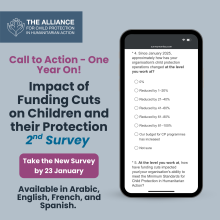
New Survey: How Are Funding Cuts Affecting Children’s Protection?
Poster
One year after major global funding reductions, the Alliance is gathering updated evidence on how these ongoing cuts and humanitarian system changes are affecting children and child protection services. The survey takes 15–20 minutes, is anonymous, and is designed to capture experiences across levels— especially practitioners working at country and sub-national levels. Take the survey in English...

New Briefing Note! Global Impact of Humanitarian Funding Cuts on Children’s Protection

Poster
Drawing on input from over 250 child protection practitioners in 55 countries, and insights from five leading child protection agencies, this new brief on the "Global Impact of Humanitarian Funding Cuts on Children and Their Protection in Humanitarian Contexts" presents stark evidence of the catastrophic consequences that ongoing funding cuts are having on children’s safety and well-being...

Key Tools

Brief | Global Impact of Funding Cuts on Children and their Protection in Humanitarian Contexts

Cover

Children have the right to be protected from abuse, neglect, exploitation, and violence. Yet, in humanitarian crises children suffer first and most, with devastating consequences for their immediate safety and long-term well-being. The humanitarian system is under unprecedented strain. Major donors, including the US and key European governments, have drastically reduced humanitarian funding or

Guidance Note | Resources for Conducting Ethical Research with Children in Humanitarian Contexts

Cover

This Resource List catalogues critical resources to guide ethical good practices in participatory research with children in humanitarian contexts. It is not an exhaustive compilation, nor does it propose new ethical guidelines. Instead, it highlights existing tools that help researchers and practitioners understand, utilise, and apply well-established ethical principles. 

These resources are

Enhanced CPMS Indicators Table

Enhanced CPMS Indicators Table

An easy-to-navigate PDF, the Enhanced CPMS Indicators Table includes the 28 Child Protection Minimum Standards and their indicators with type, target values and explanatory notes plus suggested computation methods and data source examples. Developed by the Assessment, Measurement and Evidence Working Group, this tool is part of the measurement framework of the CPMS 2019 edition.

Resources

Guidance Note | Qualitative Assessment Approaches for the Protection of Children with Disabilities Within Humanitarian Contexts

Cover
Children with disabilities are particularly vulnerable in humanitarian settings, yet they are often not able to access the services and protection they need. While multiple factors create these barriers, a major cause is how data about children with disabilities is collected and mapped. Data collection processes often exclude or underrepresent the views of children with disabilities and thier...

Guidance | A Brief Guide: Selecting Child Protection Minimum Standards Indicators for Application in Programs, Projects or Humanitarian Response Plans

Cover
This guidance document provides information on the Child Protection Minimum Standards (CPMS) measurement framework. Traditionally, accountability measures in Child Protection in Humanitarian Action (CPHA) have focused on meeting output benchmarks (such as number of people trained, number of community awareness campaigns carried out, or number referrals to service providers made), rather than...

Position Paper | Defining Evidence-Based Practice for Application in Child Protection in Humanitarian Action

Cover
There is widespread recognition among practitioners and researchers of the need to build a stronger evidence base for child protection work in humanitarian settings to be able to determine what approaches and practices are appropriate and effective in a variety of contexts. The objective of this position paper is to create a common understanding of what makes a particular child protection...

Evidence Brief | Why Identifying Risk and Protective Factors is a Critical Step in Prevention Programming: Implications for Child Protection in Humanitarian Action

Cover
Humanitarian crises, including natural disasters, conflict, and infectious disease outbreaks threaten the health, safety and well-being of children, families, and communities. Risks to children in humanitarian settings are multiple and may include: family separation, recruitment into armed forces or groups, involvement in hazardous labor, physical or sexual abuse, psychosocial distress, injury and...

Guidance | Identifying and Ranking Risk and Protective Factors: A Brief Guide
 Cover
Recognizing the strategic importance of improving evidence- based approaches to preventing child protection issues, this guidance document was developed as part of the Alliance-led Prevention Initiative to support child protection humanitarian practitioners in their prevention programming efforts. While child protection agencies operating in humanitarian contexts generally conduct systematic risk...

Contextualizing and Measuring Child Well-Being in Humanitarian Action

Cover
The Alliance AME Working Group is excited to present the Child Well-Being Contextualisation Guide! The package of child well-being resources includes: 1) Defining and Measuring Child Well-Being in Humanitarian Action: A Contextualisation Guide Ensuring children’s well-being is generally recognised as the ultimate goal of child protection in humanitarian action (CPHA). A global definition of child...

Child Protection in Emergencies Situation and Response Monitoring Toolkit

The purpose of the toolkit is to provide guidance on how to develop and implement systems for monitoring child protection issues that affect children in humanitarian settings, as well as for monitoring the child protection response. Acknowledging the multifaceted nature of protection, this toolkit focuses only on protection of children. However, it has to be considered in the broader context of...

Summary: Review on Child Wellbeing in Humanitarian Action: Concepts, Definitions and Domains

This is a summary of the Alliance's Desk Review on Child Wellbeing in Humanitarian Action: Concepts, Definitions, and Domains. A chapter-level summary is presented in 11 postcard-sized slides, highlighting the desk review on the definition of child wellbeing in humanitarian action. Reading time: 3 minutes

Webinars

Webinar | Enhancing Parenting Practices in Humanitarian Settings: Evidence and Strategies

Poster
Discover how parenting interventions can transform lives in humanitarian crises. Our expert panel will discuss the findings of a comprehensive meta-analysis on reducing violence against children and improving family well-being in low- and middle-income countries. What You'll Learn: Key findings on the effectiveness of parenting interventions. Challenges and strategies for implementation in crisis...

Webinar | Harnessing AI and Secondary Data for Smarter Child Protection in Humanitarian Contexts

Poster
In the second instalment of the Empowering Child Protection through Evidence Webinar Series, presented by the Alliance, the CPAoR, and UNHCR, this webinar will feature case studies demonstrating how child protection actors can use data and evidence to inform their response, monitoring, and planning in humanitarian contexts. In today’s increasingly complex crises and with the abundance of data...

Webinar | Strategic Advocacy and Funding in CPHA: Leveraging Data and Evidence for Success

Poster
This webinar, hosted by the Advocacy Working Group and Assessment Measurement and Evidence Working Group, will delve into the crucial role of data and evidence in shaping advocacy strategies for child protection in humanitarian action (CPHA) and in securing funding. Through case studies and expert insights, the webinar will highlight successful examples where evidence and data have been used to...

Webinar | Capturing Voices: Evidence Generation for CAAFAG

Poster
Watch the recording in French or Spanish ! The involvement of children associated with armed forces and armed groups (CAAFAG) in evidence generation, including data collection for research and learning, is often methodologically and ethically challenging. While it is understandable that field practitioners may be hesitant to involve CAAFAG in knowledge generation activities due to the risks and...

Assessment, Measurement, and Evidence Working Group Lead's

Amon Lungu, World Vision

Camilla Fabbri, International Rescue Committee