
Enabling Interventions and Approaches
Across humanitarian action, there are established best practices to ensure programs clearly address children’s protection concerns and mitigate the risk of increased tensions or conflict. Much of this relies on the application of a variety of ‘lenses’ to analysis, monitoring and evaluation to ensure stakeholders have a deeper understanding of tensions, potential challenges, and opportunities to provide context-specific, relevant support to children and the programs meant to support them.
As a charitable and philanthropic fund working to ensure that every child around the world has access to education, the Luminos Fund recognizes its responsibility to safeguard the welfare of all children who come into contact with our organization. We believe everyone has the right to live free from...
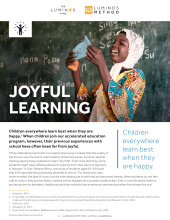
Children everywhere learn best when they are happy. However, when children join our accelerated education program, their previous experiences with school have often been far from joyful. If they attended government-run classes previously, it is likely that the quality of the lessons was low due to...
As countries seek to strengthen their national educational systems, finding ways of including all learners and ensuring that each individual has an equal opportunity for educational progress remain major challenges. This guide is intended to support countries in embedding inclusion and equity in...
The Teaching Respect for All Implementation Guide is intended for use by policymakers, teachers, school staff, students, parents and communities. Through specific questions and learning activities, users can analyse and confront their own biases. Users are encouraged to reflect upon possible actions...
Humanity & Inclusion just released a short animated video, illustrating what we mean by inclusive education and what are the key steps to remove barriers and ensure that children with disabilities access and thrive in education.
Under the USAID Education Strategy, programs should ensure equity of access to education by explicitly addressing inequalities. Inequalities in access to learning opportunities may be a consequence of any number of factors. For example, disparities in access to education can be localized or systemic...
The Conflict Sensitivity and Peacebuilding Programming Guide is a tool for UNICEF field staff and leadership to understand, situate and operationalize conflict sensitivity and peacebuilding through UNICEF’s existing work or new initiatives in different contexts and in partnership with other...
One of the aims of the Norwegian Teacher Initiative is to support education authorities of the four participating countries to elaborate strategies that will strengthen national teacher policies and the teaching and learning components of their national education sector plans. The current COVID-19...
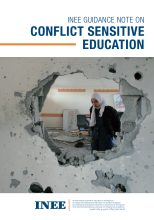
Conflict sensitive education refers to the design and delivery of education programs and policies in a way that considers the conflict context and aims to minimize the negative impact (contribution to conflict) and maximize positive impact (contribution to peace).INEE developed a Conflict Sensitive...
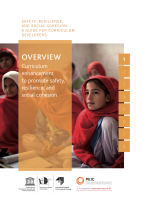
This introductory booklet is the first in a series of eight which show how to address safety, resilience, and social cohesion at every stage of the curriculum development and implementation process. It explains why education ministries should strengthen the focus on safety, resilience, and social...
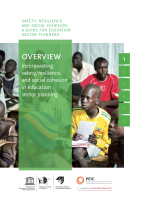
This is the first of a series of six planning booklets. It provides the context and background, the rationale as well as an overview of the phases of education sector planning. Each of the subsequent booklets provides in-depth information about each of the different phases of the planning process.In...
Through its Education Strategy, the United States Agency for International Development (USAID) committed to work with partners to increase equitable access to education for learners living in countries affected by conflict and crisis. More than half a billion children—nearly one in four—live in...
The Accelerated Education Programme (AEP) Monitoring & Evaluation (M&E) Toolkit was created by the AEWG for AEP implementers, evaluators, and agencies. The purpose of this toolkit is to support the design and implementation of M&E Frameworks for specific accelerated education programmes in order to...
Accountability to Affected People (AAP) is widely used in the humanitarian community to refer to the related commitments and mechanisms humanitarian agencies have in place to ensure that communities are meaningfully and continuously involved in decisions that directly impact their lives. Accountabil...
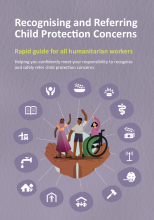
This rapid guide, developed by the Global Child Protection Area of Responsibility and Alliance for Child Protection in Humanitarian Action in collaboration with several sectors, supports all humanitarian workers to confidently recognise and safely refer child protection concerns.All humanitarian...

The first Inter-Agency Guidelines for Case Management and Child Protection were published in 2014 by the Child Protection Working Group, building on the 2012 Minimum Standards for Child Protection in Humanitarian Action (CPMS). The aim was to provide a collective understanding and step-by-step...

The Toolkit for Monitoring and Evaluating Child Protection when using Cash and Voucher Assistance (CP and CVA M&E Toolkit) is a resource for actors working in Monitoring and Evaluation, CVA (across sectors), and child protection. It aims to assess, address and monitor 1) Direct and indirect impact...
- 653 views