
Enabling Interventions and Approaches
Across humanitarian action, there are established best practices to ensure programs clearly address children’s protection concerns and mitigate the risk of increased tensions or conflict. Much of this relies on the application of a variety of ‘lenses’ to analysis, monitoring and evaluation to ensure stakeholders have a deeper understanding of tensions, potential challenges, and opportunities to provide context-specific, relevant support to children and the programs meant to support them.
Based on the INEE Conflict Sensitive Education Pack, and developed in coordination with INEE members and Truscribe, this whiteboard video illustrates conflict sensitive strategies for each of the INEE Minimum Standards five domains. This video is available in English, French, Arabic, and Spanish...
In light of the far-reaching consequences of the COVID-19 pandemic on education systems around the world, with 89% of the world’s student population affected by COVID-19 school closures as of 1 April 2020, governments and partner organizations have ramped up efforts to facilitate the continuity of...
Under the USAID Education Strategy, programs should ensure equity of access to education by explicitly addressing inequalities. Inequalities in access to learning opportunities may be a consequence of any number of factors. For example, disparities in access to education can be localized or systemic...
The Conflict Sensitivity and Peacebuilding Programming Guide is a tool for UNICEF field staff and leadership to understand, situate and operationalize conflict sensitivity and peacebuilding through UNICEF’s existing work or new initiatives in different contexts and in partnership with other...
One of the aims of the Norwegian Teacher Initiative is to support education authorities of the four participating countries to elaborate strategies that will strengthen national teacher policies and the teaching and learning components of their national education sector plans. The current COVID-19...
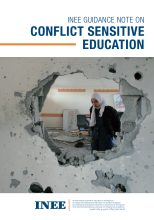
Conflict sensitive education refers to the design and delivery of education programs and policies in a way that considers the conflict context and aims to minimize the negative impact (contribution to conflict) and maximize positive impact (contribution to peace).INEE developed a Conflict Sensitive...
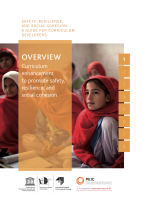
This introductory booklet is the first in a series of eight which show how to address safety, resilience, and social cohesion at every stage of the curriculum development and implementation process. It explains why education ministries should strengthen the focus on safety, resilience, and social...
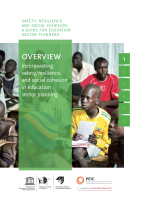
This is the first of a series of six planning booklets. It provides the context and background, the rationale as well as an overview of the phases of education sector planning. Each of the subsequent booklets provides in-depth information about each of the different phases of the planning process.In...
Through its Education Strategy, the United States Agency for International Development (USAID) committed to work with partners to increase equitable access to education for learners living in countries affected by conflict and crisis. More than half a billion children—nearly one in four—live in...
- 653 views