
Safe Access and Protective Learning Environments

Safe physical learning spaces encompass a broad range of interventions that include both the presence of protective infrastructure and the absence of protection risks. Safe learning spaces promote the general well-being of learners and education personnel and enable learners to fully engage in the learning process. Determining potential hazards and protection risks is achieved through collaborative or complementary assessments that allow for essential information gathering to inform joint or integrated interventions. Interventions may address the: 

  • Physical space to mitigate protection issues, increase safety for all, and ensure infrastructure is resilient to future shocks (E.g.: site selection, accessibility of site for all, provision of gender-segregated water and sanitation facilities) and
  • Policies, practices, and behaviors (E.g.: supporting positive discipline, disciplinary policies updated and inclusive of SGBV, bullying, etc.) that reduce harm or potential risks to learners and education personnel. 

Safe access and protective learning environments are inclusive of all center-based programming with shared child protection and education interventions, including Child Friendly Spaces, ECD centers, and Formal and Non-Formal Learning Programs.
 Cover
The Menu of Measures on Gender-Based Violence Risk Mitigation in the Education in Emergencies Sector offers a compilation of validated indicators and accompanying guidance to track the effectiveness of GBV risk mitigation interventions in education in emergencies programming. This tool aims to equip...
 Cover
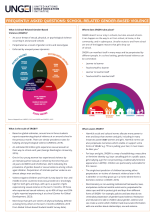
Globally, school-related gender-based violence (SRGBV) impacts 246 million children andadolescents a year. UNESCO defined SRGBV as “acts or threats of sexual, physical orpsychological violence occurring in and around schools perpetrated as a result of gendernorms and stereotypes and enforced by...
 Cover
This volume aims to encourage concerted action by highlighting the scale and consequences of homophobic bullying and to share good policy and programming approaches. Interventions are needed at primary, secondary and tertiary levels of the education system and examples are included from all three...
 Cover
School-Related Gender-Based Violence (SRGBV) affects children worldwide. Based on global estimates, around one in three students reports experiencing physical violence at or around school in the previous month. There are similar prevalence rates for bullying and psychological violence. Learn more...
 Cover
This paper shines a light on sexual violence in education settings. It covers forced, non-consensual or exploitative sexual acts perpetrated in, around or related to an education setting. While sexual violence against children and young people is already a less-researched area of work, this focus on...
 Cover
This guidance aims to provide a comprehensive, one-stop resource on school-related gender-based violence (SRGBV), including clear, knowledge-based operational guidance, diverse case studies drawn from examples of promising practice and recommended tools for the education sector and its partners...
 Cover
The purpose of this guide is to present a set of minimum standards for a whole school approach to prevent and respond to school-related gender-based violence (SRGBV) and a monitoring framework to measure the effectiveness of the approach. A whole school approach is a strategy that takes into account...