

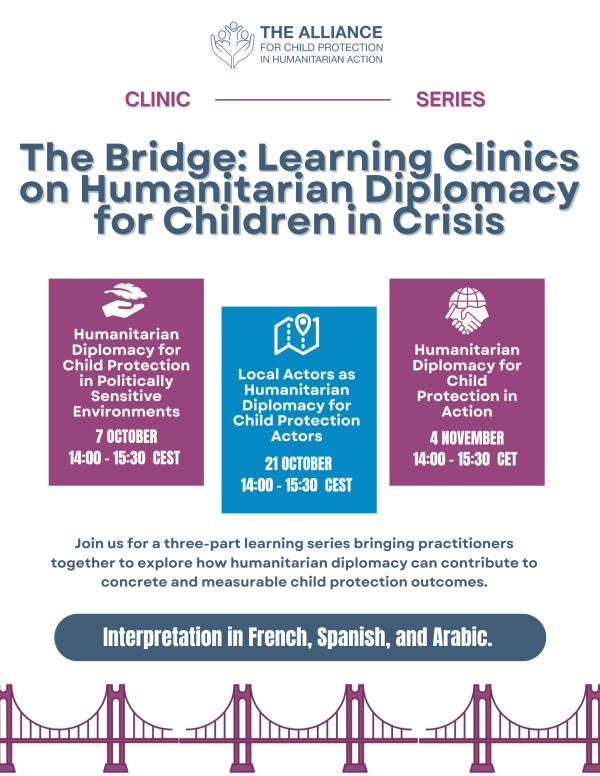
The Bridge: Learning Clinics on Humanitarian Diplomacy for Children in Crisis
How can humanitarian diplomacy contribute to concrete and measurable child protection outcomes?
This series of three interactive Learning Clinics explored how child protection practitioners can use humanitarian diplomacy to influence the decisions, behaviours, and systems that shape children’s exposure to harm.
Designed as practical spaces for learning and exchange, each clinic brought together practitioners with diverse experiences to explore real cases, operational challenges, and lessons from different humanitarian contexts. Through facilitated discussions and participant exchange, the series examined the choices, adaptations, and relationships that can help translate humanitarian diplomacy into meaningful outcomes for children.
Humanitarian Diplomacy for Child Protection in Politically Sensitive Environments
🗓 7 October | ⏰ 14:00-15:30 CEST |📍 Zoom
📺 Watch the Recording
🔹 Explored how humanitarian actors can maintain meaningful engagement on sensitive child protection concerns when harms are denied, contested, or politically difficult to acknowledge. The discussion centred around how practitioners navigate language and framing, confidential and public engagement, operational access, organisational risk, and the safety of affected people and partners.
🗣️ Speakers:
- Kristen Hope, University of Bath: Research and conceptual perspectives on child protection and humanitarian diplomacy.
- Jennifer Dabis, Director of Development, Juzoor for Health and Social Development: The perspective of a Palestinian organization working in Gaza and the wider occupied Palestinian territory.
- Alexandre Munafò, Head of Humanitarian Diplomacy and Communications, Geneva Call: Experience of humanitarian dialogue, with a particular focus on Ukraine.
Local Actors as Humanitarian Diplomacy for Child Protection Actors
🗓 21 October | ⏰ 14:00-15:30 CEST |📍 Zoom
📺 Watch the Recording
🔹 Explored the critical role of local and national actors in humanitarian diplomacy, including the unique access, relationships, legitimacy, and influence they bring. The clinic highlighted how the humanitarian system can better recognise and support locally led diplomacy, share decision-making and access to influential spaces, and ensure that greater local leadership does not result in disproportionate risk transfer.
🗣️ Speakers:
- Jonas Habimana, Head of Office, BIFERD, Democratic Republic of the Congo: Direct experience of humanitarian diplomacy and advocacy for child protection in DRC.
- Nataliia Kirkach, Chairwoman/Director, Slavic Heart, Ukraine: A concrete experience of humanitarian diplomacy or advocacy for child protection in Ukraine.
Humanitarian Diplomacy for Child Protection in Action
🗓 4 November | ⏰ 14:00-15:30 CET |📍 Zoom
📺 Watch the Recording
🔹 Explored concrete country experiences where humanitarian actors have sought to influence decisions, behaviours, or practices affecting children. Through real cases, practitioners unpacked what happened behind the scenes—from selecting interlocutors and diplomatic channels to navigating resistance, adapting strategies, and identifying what ultimately contributed to progress.
🗣️ Speakers:
- Roisin Mangan, Humanitarian Affairs Advisor, Médecins Sans Frontières (MSF): Insights from Myanmar on navigating complex humanitarian environments and using humanitarian diplomacy to influence policy and decision-making.
- Hilda B. Molano Casas, Coordinadora Secretaría Técnica, COALICO: Experiences from Colombia engaging with government authorities and other influential actors to advocate for children's rights and strengthen their access to justice.
Each clinic featured facilitated discussion with practitioners, interactive exercises, and opportunities for participants to share experiences, ask questions and reflect on how lessons can be applied in their own contexts.