

- A Time of Transition: Adolescents in Humanitarian Settings, Plan International, 2016.
- ‘Adolescent Girls’, Women’s Refugee Commission.
- Girl-Centered Program Design: A Toolkit to Develop, Strengthen and Expand Adolescent Girls Programs, Population Council, 2010.
- ‘I’m Here: Adolescent Girls in Emergencies’, Women’s Refugee Commission, 2018.
- ‘Gender-Age Marker Toolkit’, ECHO, 2014.
- Early Childhood Development and Child Protection in Emergencies: Technical Note, Plan International and UNICEF, 2016.
- Early Childhood Development and Child Protection Brief for Emergencies, Plan International and UNICEF, 2016.
- Early Childhood Development Resource Pack, UNICEF.
- Care for Child Development Package, UNICEF, 2012.
- Excessive Stress Disrupts the Architecture of the Developing Brain: Working Paper 3, National Scientific Council on the Developing Child, 2005/2014.
- A Good Start: Advances in Early Childhood Development, Early Childhood Matters, Bernard van Leer Foundation, 2015(24).
- ‘Child Protection’, Including Children with Disabilities in Humanitarian Action, UNICEF, 2017.
- Humanitarian Inclusion Standards for Older People and People with Disabilities, CBM International, Bensheim, HelpAge International, London, Handicap International, Lyon, 2018.
- IASC Guidelines on Inclusion of Persons with Disabilities in Humanitarian Action, 2019.
- Gender-based Violence Against Children and Youth with Disabilities: A Toolkit for Child Protection Actors, Child Fund, 2016.
- Individual Case Management: Identifying and Responding to the Needs of Persons with Disabilities [Training Tools], Women’s Refugee Commission, 2013.
- Promoting Gender Equality Through UNICEF-Supported Programming in Child Protection: Operational Guidance, UNICEF, 2011.
- Child Protection: Thematic Area Guide for Guidelines for Integrating Gender-Based Violence Interventions in Humanitarian Action, Inter-Agency Standing Committee, 2015.
- The Gender Handbook in Humanitarian Action, IASC, 2017.
- Transforming Inequalities, Transforming Lives: Save the Children Principles for Gender Equality, Save the Children, 2014.
- Engendering Transformational Change: Save the Children Gender Equality Program Guidance & Toolkit, Save the Children, 2014.
- Caring for Child Survivors of Sexual Abuse: Guidelines for Health and Psychosocial Service Providers in Humanitarian Settings, International Rescue Committee and UNICEF, 2012.
- Interagency Study on Child-Friendly Feedback and Complaint Mechanisms Within NGO Programmes, Educo, Plan International, Save the Children UK, War Child UK and World Vision International, 2015.
- Bennouna, Cyril, Hani Mansourian and Lindsay Stark, ‘Ethical considerations for children’s participation in data collection activities during humanitarian emergencies: A Delphi review’, Conflict and Health, 2017 (11:5).
- Children's MIRA: Listening to Children During Emergencies (A Tool for Conducting Multi-Cluster Initial Rapid Assessments with Children), Save the Children, 2016.
- ‘Compact for Young People in Humanitarian Action’, World Humanitarian Summit, 2016.
- Children and Young People’s Participation: An Essential Approach for Ending Violence Against Children, World Vision, 2017.
- Children’s Participation in Decision Making: Why Do It, When to Do It, How to Do It, Inter-Agency Working Group on Children’s Participation (IAWGCP), 2007.
- Every Child's Right to Be Heard: A Resource Guide on the UN Committee on the Rights of the Child General Comment No 12, Save the Children Fund, 2011.
- Guidelines for Children's Participation in Humanitarian Programming, Save the Children, 2013.
- A Toolkit for Monitoring and Evaluating Children’s Participation, Save the Children, 2014.
- Children's Right to be Heard and Effective Child Protection: A Guide for Governments and Children´s Rights Advocates in Involving Children and Young People in Ending all Forms of Violence, Save the Children Sweden, 2010.
- Take Us Seriously! Engaging Children with Disabilities in Decisions Affecting Their Lives, UNICEF, 2013.
- The Neglected Link: Effects of Climate Change and Environmental Degradation on Child Labour, Terre des hommes, 2017.
- ‘UN Environment/OCHA Joint Unit: Environment Marker’, UNEP and UNOCHA, 2014.
- Danger in the Air: How Air Pollution May Be Affecting the Brain Development of Young Children Around the World, UNICEF, 2017.
- Unless We Act Now: The Impact of Climate Change on Children, UNICEF, 2015.
- The Challenges of Climate Change: Children on the Front Line, UNICEF, 2014.
Refugees, Internally Displaced and Migrant Population Settings:
- Inter-agency Guiding Principles on Unaccompanied and Separated Children, Inter-Agency, 2004.
- Field Handbook on Unaccompanied and Separated Children, IAWG UASC and the Alliance for Child Protection in Humanitarian Action, 2016.
- Bhabha, Jacqueline and Mike Dottridge, Child Rights in the Global Compacts: Recommendations for Protecting, Promoting and Implementing the Human Rights of Children on the Move in the Proposed Global Compacts (Working Document), 2017.
- Guidelines on Assessing and Determining the Best Interests of the Child: 2018 Provisional Release, UNHCR, 2018.
- A Framework for the Protection of Children, UN High Commissioner for Refugees (UNHCR), 2012.
- ‘The 10-Point Plan in Action’, UN High Commissioner for Refugees (UNHCR), 2016.
- ‘Recommended Principles to Guide Actions Concerning Children on the Move and Other Children Affected by Migration’, 2016, OHCHR.
- Children on the Move, IOM, 2013.
- IFRC Position Paper: Protection and Assistance for Children on the Move, IFRC, 2017.
- Manual on Smart Practices for Working with Migrant Unaccompanied and Separated Children in the Europe Region, IFRC, Geneva, 2017.
- ‘Joint General Comment No. 3 (2017) of the Committee on the Protection of the Rights of All Migrant Workers and Members of Their Families and No. 22 (2017) of the Committee on the Rights of the Child on the General Principles Regarding the Human Rights of Children in the Context of International Migration (CMW/C/CG/3-CRC/C/GC/22)’, United Nations Committee on the Protection of the Rights of All Migrant Workers and Members of Their Families (CMW), 2017.
- ‘Joint General Comment No. 4 (2017) of the Committee on the Protection of the Rights of All Migrant Workers and Members of Their Families and No. 23 (2017) of the Committee on the Rights of the Child on State Obligations Regarding the Human Rights of Children in the Context of International Migration in Countries of Origin, Transit, Destination and Return (CMW/C/GC/4-CRC/C/GC/23)’, United Nations Committee on the Protection of the Rights of All Migrant Workers and Members of Their Families (CMW), 2017.
Infectious Disease Outbreak Settings:
- Guidance Note: Protection of Children During Infectious Disease Outbreaks, The Alliance for Child Protection in Humanitarian Action, 2018.
- Care and Protection of Children in the West African Ebola Virus Disease Epidemic: Lessons Learned for Future Public Health Emergencies, UNICEF, 2016.
- ‘Resolution adopted by the General Assembly on 23 December 2016: 71/256. New Urban Agenda (A/RES/71/256)’, United Nations General Assembly, 2017.
- The State of the World’s Children 2012: Children in an Urban World, UNICEF, 2012.
- Making Sense of the City: Developing Evidence Through Action Research and Learning (Revised Edition), World Vision International, 2016.
- Violence in the City: A Systematic Review of the Drivers of Violence Against Displaced Populations in Urban Crisis and Post-crisis Settings, IRC, 2017.
- Child-centred Urban Resilience Framework: A Holistic, Systematic and Action-based Framework for Making Cities More Resilient for Children and Youth, Girls and Boys, Plan International, Australian Aid, the Government of Sweden and ARUP, 2016.
- ‘Child Protection in Emergencies (CPiE) Mobile Teams’, Child Protection Sub-Cluster Iraq, 2017.
- ‘Emergency Mobile Teams: Gender-based Violence (GBV)’, GBV Sub-Cluster Iraq.
- ‘Mobile SGBV Prevention and Response Services: Lebanon’, Gender Equality Promising Practices: Syrian Refugees in the Middle East and North Africa, UNHCR, 2017.
- Thompson, H., Cash and Child Protection: How Cash Transfer Programming can Protect Children from Abuse, Neglect, Exploitation, and Violence, Save the Children Fund, 2012.
- Child Safeguarding in Cash Transfer Programming: A Practical Tool, The Cash Learning Partnership, Save the Children, Women’s Refugee Commission, 2012.
- Safer Cash Toolkit, IRC, 2019.
- Child Safeguarding for Cash and Voucher Assistance: Guidance, Save the Children, 2019.
- Cash Transfer Programming in the Education and Child Protection sectors: Literature Review and Evidence Maps, Cash Learning Partnership, The London School of Economics and Political Science, The London School of International Development, 2018.
- Mishra, Anjini and Francesca Battistin, Child Outcomes of Cash Transfer Programming: A Synthesis of Evidence Around Survival, Education, and Protection in Humanitarian and Non-humanitarian Contexts, Save the Children, 2018.
- Cash Based Assistance: Programme Quality Toolbox, The Cash Learning Partnership (CALP), 2018.
- Guide for Protection in Cash-based Interventions: Improving Cash-based Interventions, Multipurpose Cash Grants and Protection (Enhanced Response Capacity Project 2014-2015), UNHCR, 2015.
- ‘Appendix: Delivering Assistance Through Markets’, The Sphere Handbook: Humanitarian Charter and Minimum Standards in Humanitarian Response, Sphere Association, 2018.
- ‘Adapting to learn, learning to adapt’: Overview of and Considerations for Child Protection Systems Strengthening in Emergencies, Alliance for Child Protection in Humanitarian Action, 2016.
- A Better Way to Protect ALL Children: The Theory and Practice of Child Protection Systems (Conference Report), UNICEF, UNHCR, Save the Children and World Vision, 2013.
- Core Humanitarian Standard on Quality and Accountability, CHS Alliance, Group URD, the Sphere Project, 2014.
- The World’s Stateless, Institute on Statelessness and Inclusion, 2014.
- Birth Registration in Emergencies Toolkit, Plan International, 2017.
- Harrowing Journeys: Children and Youth on the Move Across the Mediterranean Sea, at Risk of Trafficking and Exploitation, IOM and UNICEF, 2017.
- ‘New Data From the World’s First Data Portal to Include Human Trafficking Data Contributed by Multiple Agencies’, Counter-trafficking Data Collaborative (CTDC), 2017.
- Addressing Human Trafficking and Exploitation in Times of Crisis: Evidence and Recommendations for Further Action to Protect Vulnerable and Mobile Populations (December 2015), IOM, 2015.
- Caring for Trafficked Persons: Guidance for Health Providers, IOM, 2009.
- The IOM Handbook on Direct Assistance for Victims of Trafficking, IOM, 2007.
- Guidelines on the Protection of Child Victims of Trafficking: UNICEF Technical Notes, UNICEF, 2006.
- Core Humanitarian Standard on Quality and Accountability, CHS Alliance, Group URD, the Sphere Project, 2014.
- ‘General Assembly Resolution 46/182: Strengthening of the coordination of humanitarian emergency assistance of the United Nations, A/RES/46/182’, UN General Assembly, 19 December 1991.
- ‘How field based protection clusters and sub-clusters work together: Q&A’, Global Protection Cluster, 2015.
- ‘UNHCR Refugee Response Coordination: Frequently Asked Questions’, UNHCR, 2014.
- Preparedness Package for Refugee Emergencies, UNHCR, 2018.
- ‘Resolution 319 (XI): Refugees and stateless persons, 16 August 1950, E/RES/319 (XI)’, UN Economic and Social Council (ECOSOC), 1950.
- ‘Note on the Mandate of the High Commissioner for Refugees and his Office’, UNHCR, 2013.
- ‘Principles of Partnership: Statement of Commitment’, Global Humanitarian Platform, 2007.Further resources - anchor doc.docx
- Guidelines for Integrating Gender-Based Violence Interventions in Humanitarian Action, Inter-Agency Standing Committee, 2015.
- UNHCR Policy on Age, Gender and Diversity, 2018, UNHCR.
- ‘The Age, Gender, Diversity Approach’, Global Protection Cluster, 2019.
- ‘Decent Work’, International Labour Organization.
- Csáky, Corinna, No One to Turn To: The Under-reporting of Child Sexual Exploitation and Abuse by Aid Workers and Peacekeepers, Save the Children, 2008.
- ‘Guiding Principles of the Convention on the Rights of Persons with Disabilities’, United Nations.
- Choose with Care: 12 steps to a Child Safe Organisation, Child Wise, 2010, https://www.childwise.org.au/news/15/12-steps-to-changing-your-organisational-culture-to-be-child-safe
- ‘Including Children with Disabilities in Humanitarian Action’, UNICEF, 2017.
Standard 3: Communications and Advocacy:
- Guidance Note for Reviewing Child Protection in Emergencies Proposals, The Alliance for Child Protection in Humanitarian Action, Child Protection Area of Responsibility, 2017.
- Thompson, Hannah, A Matter of Life and Death: Child protection programming's essential role in ensuring child wellbeing and survival during and after emergencies, The Child Protection Working Group, 2015.
- Lilley, Sarah, Johanna MacVeigh, Christine McCormick and Misty Buswell, Too Little, Too Late: Child protection funding in emergencies, The Child Protection Working Group, 2010.
- ‘General Comment No.12 (2009): The right of the child to be heard’, CRC/C/GC/12, United Nations Committee on the Rights of the Child, 2009.
- Humanitarian Inclusion Standards for Older People and People with Disabilities, CBM International, Bensheim, HelpAge International, London, Handicap International, Lyon, 2018.
- Young People’s Participation in Peacebuilding: A Practice Note, Inter-Agency Network on Youth Development Working Group on Youth and Peacebuilding, 2016.
- ‘Child Protection’, Including Children with Disabilities in Humanitarian Action, UNICEF, 2017.
Standard 4: Programme Cycle Management:
Child Protection-Specific Resources:
- Action for the Rights of Children (ARC) Resource Pack: A Capacity-building Tool for Child Protection in and after Emergencies, ARC Steering Committee, Save the Children, 2009.
- The Sphere Handbook: Humanitarian Charter and Minimum Standards in Humanitarian Response, Sphere Association, 2018.
- ‘Indicator Registry’, OCHA Services, OCHA.
- ‘UNHCR Operations Management Cycle’, UNHCR Emergency Handbook, UNHCR.
- ‘The Humanitarian Programme Cycle: How We Manage Humanitarian Response’, OCHA.
- Operational Guidance for Coordinated Assessments in Humanitarian Crises, IASC, 2012.
- Multi-sector Initial Rapid Assessment: Guidance, IASC, 2015.
- ‘Needs Assessment in Refugee Emergencies (NARE)’, UNHCR Emergency Handbook, UNHCR.
- Bonino, F. with Jean, I. and P. Knox Clarke, Closing the Loop: Effective Feedback in Humanitarian Contexts (Practitioner Guidance), ALNAP/ODI, 2014.
- Evaluation of Protection in Humanitarian Action: ALNAP Guide, ALNAP/ODI, London, 2018.
- Humanitarian Inclusion Standards for Older People and People with Disabilities, CBM International, Bensheim, HelpAge International, London, Handicap International, Lyon, 2018.
- ‘Child Protection’, Including Children with Disabilities in Humanitarian Action, UNICEF, 2017.
Child Participation and Ethical Considerations for involving Children in Programming:
- Practice Standards in Children’s Participation, Save the Children, 2005.
- Graham, A., M. Powell, N. Taylor, D. Anderson and R. Fitzgerald, Ethical Research Involving Children, UNICEF Office of Research – Innocenti, Florence, 2013.
- Bennouna, Cyril, Hani Mansourian and Lindsay Stark, ‘Ethical considerations for children’s participation in data collection activities during humanitarian emergencies: A Delphi review’, Conflict and Health, 2017 (11:5).
- Child Safeguarding Standards and How to Implement Them, Keeping Children Safe, 2014.
Standard 5: Information Management:
- ‘Child Protection Area of Responsibility’.
- ‘The Alliance for Child Protection in Humanitarian Action’.
- ‘CPIMS+’.
- ‘Including Children with Disabilities in Humanitarian Action’, UNICEF.
- Information and Communication Technology for Child Protection Case Management in Emergencies: A Framework for Design, Implementation and Evaluation, UNICEF, UNHCR and ICRC, 2016.
Standard 6: Child Protection Monitoring:
- PIM Principles, PIM Process, and A Framework for Data Sharing in Practice, ‘Guidance and Products Archive’, Protection Information Management (PIM).
- Ethical and Safety Recommendations for Researching, Documenting and Monitoring Sexual Violence in Emergencies, WHO, 2007.
- Guidelines for Interviewing Children, UNICEF.
- Data Analysis Plan: Template, UNHCR.
- Professional Standards for Protection Work Carried out by Humanitarian and Human Rights Actors in Armed Conflict and Other Situations of Violence, ICRC, 2018, pp. 103–150.
- Guidance Note: Multi-Sectoral Analytical Framework for Secondary Data Reviews in Emergencies, UNICEF and ACAPS, 2016.
- UNICEF Procedure for Ethical Standards in Research, Evaluation Data Collection and Analysis, UNICEF, 2015.
- Handbook on Data Protection in Humanitarian Action, ICRC, 2018.
- Sector Severity and Priority IDP Locations with DTM Data: A UNICEF Step-by-step Guide for Child Protection, WASH and Education Cluster Coordinators and IMOs, UNICEF and IOM, 2018.
- ‘DTM Field Companion Protection’, IOM.
- O’Kane, Claire, Guidelines for Children’s Participation in Humanitarian Programming, Save the Children, 2013.
Standard 7: Dangers and Injuries:
- Child Protection in Humanitarian Action Review: Dangers and Injuries, Alliance for Child Protection in Humanitarian Action, Child Protection AoR, 2016.
- Global Health Estimates 2016: Disease burden by Cause, Age, Sex, by Country and by Region, 2000-2016, WHO, Geneva, 2018.
- International Classification of Functioning, Disability and Health (ICF), WHO, 2013.
- ‘Convention on the Rights of Persons with Disabilities (CRPD)’, UN Department of Economic and Social Affairs: Disability, 2006.
- ‘International Campaign to Ban Landmines’.
- ‘The Convention on Cluster Munitions’, 2010 [Entry into force].
- ‘Convention on the Prohibition of the Use, Stockpiling, Production and Transfer of Anti-Personnel Mines and on their Destruction’, United Nations, 1997.
- ‘Convention on Prohibitions or Restrictions on the Use of Certain Conventional Weapons Which May Be Deemed to Be Excessively Injurious or to Have Indiscriminate Effects as Amended on 21 December 2001’, United Nations, 2001.
Standard 8: Physical and Emotional Maltreatment:
- Covell, Katherine and Jo Becker, Five Years On: A Global Update on Violence Against Children, NGO Advisory Council for Follow-Up to the UN Study on Violence Against Children, 2011.
- Pinheiro P.S., World Report on Violence Against Children, United Nations Secretary-General’s Study on Violence Against Children, 2006.
- Child Disciplinary Practices at Home: Evidence from a Range of Low- and Middle-Income Countries, UNICEF, 2010.
- INSPIRE: Seven Strategies for Ending Violence Against Children, World Health Organization (WHO), 2016.
- Preventing Child Maltreatment: A Guide to Taking Action and Generating Evidence, WHO, 2006. [Available in Arabic, English, French, Chinese, Italian, Spanish.]
- Violence Prevention: The Evidence, WHO, 2010.
- ‘Child Protection’, Including Children with Disabilities in Humanitarian Action, UNICEF, 2017.
- Hillis, Susan, James Mercy, Adaugo Amobi, Howard Kress, ‘Global Prevalence of Past-year Violence Against Children: A Systematic Review and Minimum Estimates, Pediatrics, 2016, 137(3): e20154079.
Standard 9: Sexual and Gender-Based Violence:
- ‘Girls Not Brides’. [Website with tools and resources to prevent and respond to child marriage.]
- Gender-Based Violence Against Children and Youth with Disabilities: A Toolkit for Child Protection Actors, Women’s Refugee Commission and Child Fund, 2016.
Standard 10: Mental Health and Psychosocial Distress:
- The Sphere Handbook: Humanitarian Charter and Minimum Standards in Humanitarian Response, Sphere Association, 2018.
- Child Protection Issue Brief: Mental Health and Psychosocial Well-being of Children, UNHCR, 2014.
- IASC, Who is Where, When, Doing What in Mental Health and Psychosocial Support (4W Tool), IASC Secretariat, 2014.
- Mental Health and Psychosocial Support for Refugees, Asylum Seekers and Migrants on the Move in Europe: A Multi-Agency Guidance Note, 2015.
- Action for the Rights of Children (ARC) Resource Pack: A Capacity-building Tool for Child Protection in and after Emergencies, ARC Steering Committee, Save the Children, 2009.
- Including Children with Disabilities in Humanitarian Action, UNICEF, 2017.
- mhGAP Humanitarian Intervention Guide (mhGAP-HIG): Clinical Management of Mental, Neurological and Substance Use Conditions in Humanitarian Emergencies, WHO and UNHCR, 2015.
- IFRC Monitoring and Evaluation Framework for Psychosocial Support Interventions: Toolbox, IFRC 2017.
- IASC, Mental Health and Psychosocial Support in Emergency Settings: What Should Protection Programme Managers Know? 2011, IASC, Geneva, 2011.
- Operational Guidance: Mental Health and Psychosocial Support Programming for Refugee Operations, UN High Commissioner for Refugees (UNHCR), 2013.
Standard 11: Children Associated with Armed Forces and Armed Groups:
- ‘Optional Protocol to the Convention on the Rights of the Child on the Involvement of Children in Armed Conflict’, A/RES/54/263, UN General Assembly, 2000.
- ‘Protocol Additional to the Geneva Conventions of 12 August 1949, and Relating to the Protection of Victims of International Armed Conflicts (Protocol I), 8 June 1977’.
- ‘Protocol Additional to the Geneva Conventions of 12 August 1949, and Relating to the Protection of Victims of Non-International Armed Conflicts (Protocol II), 8 June 1977’.
- ‘The Paris Commitments Consolidated Version: Paris Commitments to Protect Children from Unlawful Recruitment or Use by Armed Forces or Armed Groups’, 2007.
- ‘The Paris Principles: Principles and Guidelines on Children Associated with Armed Forces or Armed Groups’, 2007.
- ‘C182 – Worst Forms of Child Labour Convention, 1999 (No. 182)’, 2000.
- Cradled by Conflict: Child Involvement with Armed Groups in Contemporary Conflict, United Nations University, 2018.
- ‘Office of the Special Representative of the Secretary-General for Children and Armed Conflict’.
- ‘Child Protection’, Including Children with Disabilities in Humanitarian Action, UNICEF, 2017.
- ‘Safe Work for Youth’ Kit, ILO, 2010.
- Manual on Child Labour Rapid Assessment Methodology, ILO and UNICEF, Geneva, 2005.
- The Tripartite Process of Determining Hazardous Child Labour Guide for Facilitators: Eliminating Hazardous Child Labour Step by Step, ILO and IPEC, Geneva, 2012.
- Supporting Children’s Rights Through Education, the Arts and the Media (SCREAM): A Special Module on Child Labour and Armed Conflict, International Training Centre of the International Labour Organization, 2010.
- Guidelines for developing child labour monitoring (CLM) processes, ILO, 2005.
- Addressing Human Trafficking and Exploitation in Times of Crisis: Evidence and Recommendations for Further Action to Protect Vulnerable and Mobile Populations, IOM, 2015.
- Caring for Trafficked Persons: Guidance for Health Providers, IOM, LSHTM and UN.GIFT, 2009.
- Harrowing Journeys: Children and Youth on the Move Across the Mediterranean Sea, at Risk of Trafficking and Exploitation, IOM and UNICEF, 2017.
- Guidelines on the Protection of Child Victims of Trafficking: UNICEF Technical Notes, UNICEF, 2006.
- Child Safeguarding for Cash and Voucher Assistance: Guidance, Save the Children, 2019.
- ‘Optional Protocol to the Convention on the Rights of the Child on the Involvement of Children in Armed Conflict’, A/RES/54/263, UN General Assembly, 2000.
- ‘Optional Protocol to the Convention on the Rights of the Child on the Sale of Children, Child Prostitution and Child Pornography’, A/RES/54/263, 2002.
- ‘C138 – Minimum Age Convention, 1973 (No. 138)’, 1976.
- ‘C182 – Worst Forms of Child Labour Convention, 1999 (No. 182)’, 2000.
- Child Labour Statistics: Manual on Methodologies for Data Collection Through Surveys, ILO, Geneva, 2004.
- ‘Protocol to Prevent, Suppress and Punish Trafficking in Persons Especially Women and Children, Supplementing the United Nations Convention against Transnational Organized Crime’, 55/25, UN General Assembly, 2000.
Standard 13: Unaccompanied and Separated Children:
- Inter-agency Guiding Principles on Unaccompanied and Separated Children, Inter-Agency, 2004.
- Guidelines on Children’s Reintegration, Inter-agency Group on Children’s Reintegration, 2016.
- ‘General Comment No.6 (2005): Treatment of Unaccompanied and Separated Children Outside their Country of Origin’, Committee on the Rights of the Child, 2005.
- Field Handbook for the Implementation of UNHCR BID Guidelines, UNHCR and IRC, 2011.
- ‘Global Compact for Safe, Orderly and Regular Migration’, A/RES/73/195, UN General Assembly, 2019.
- Report of the United Nations High Commissioner for Refugees Part II: Global Compact on Refugees, A/73/12, UN General Assembly, 2018.
- Williamson, J. & Greenberg, A. Families, Not Orphanages: Better Care Network Working Paper, Better Care Network, 2010.
- Alternative Care in Emergencies Toolkit, Interagency Working Group on Separated and Unaccompanied Children, 2013.
- Child Protection Case Management Training for Caseworkers, Supervisors and Managers, The Alliance for Child Protection in Humanitarian Action, 2014.
Standard 14: Applying a Socio-Ecological Approach to Child Protection Programming:
- Handbook for Working with Children and Youth: Pathways to Resilience Across Cultures and Contexts, SAGE Publications, Inc., 2005.
Standard 15: Group Activities for Child Well-Being:
- ‘Evaluation of Child Friendly Spaces: An Inter-agency Series of Impact Evaluations in Humanitarian Emergencies’, World Vision International, Columbia University, Save the Children and UNICEF, 2015.
- Austrian, K. and G. Dennitah, Girl-Centered Program Design: A Toolkit to Develop, Strengthen and Expand Adolescent Girls Programs, Population Council, 2010.
Standard 16: Strengthening Family and Caregiving Environments:
None at this time.
Standard 17: Community-Level Approaches:
- ‘Adapting to learn, learning to adapt’: Overview of and Considerations for Child Protection Systems Strengthening in Emergencies, Alliance for Child Protection in Humanitarian Action, 2016.
- Wessells, M., What Are We Learning About Protecting Children in the Community? An Inter-Agency Review of Evidence on Community-based Child Protection Mechanisms, Save the Children Fund, London, 2009.
- Caring for Child Survivors of Sexual Abuse: Guidelines for Health and Psychosocial Service Providers in Humanitarian Settings, International Rescue Committee and UNICEF, 2012.
- Information and Communication Technology for Child Protection Case Management in Emergencies: A Framework for Design, Implementation and Evaluation, UNICEF, UNHCR and ICRC, 2016.
- Case Management Practice Within Save the Children Child Protection Programmes, Save the Children UK, 2011.
- O’Leary, Patrick and Jason Squire, Case Management: Systems and Accountability (Social Work in Child Protection Projects 2009), Terre des hommes, UniSA and University of Bath, 2009.
- IASC Guidelines on Mental Health and Psychosocial Support in Emergency Settings, Inter-Agency Standing Committee (IASC), Geneva, 2007.
Standard 19: Alternative Care:
- ‘Convention on Protection of Children and Co-Operation in Respect of Intercountry Adoption’, Hague Conference on Private International Law (HCCH), 1993.
- ‘Child Protection Issue Brief: Alternative Care’, UNHCR, 2014.
- ‘Intercountry Adoption: Policy Brief, June 2012’, Save the Children, 2012.
Standard 20: Justice for Children:
- Strengthening the Medico-legal Response to Sexual Violence, WHO and UNODC, 2015.
- ‘Convention Against Torture and Other Cruel, Inhuman or Degrading Treatment or Punishment’, 39/46, UN General Assembly, 1984.
- ‘United Nations Standard Minimum Rules for the Administration of Juvenile Justice (‘The Beijing Rules’)’, 40/33, UN General Assembly, 1985.
- ‘United Nations Rules for the Protection of Juveniles Deprived of their Liberty’, 45/113, UN General Assembly, 1990.
- ‘United Nations Guidelines for the Prevention of Juvenile Delinquency (The Riyadh Guidelines)’, 45/112, United Nations General Assembly, 1990.
- ‘Convention on the Rights of the Child’, United Nations General Assembly, 1989.
- ‘Convention on the Rights of Persons with Disabilities (CRPD)’, UN Department of Economic and Social Affairs: Disability, 2006.
- ‘General Comment No. 10 (2007): Children’s Rights in Juvenile Justice’, CRC/C/GC/10, UN CRC, 2007.
- The United Nations Standard Minimum Rules for the Treatment of Prisoners (The Nelson Mandela Rules), United Nations Office on Drugs and Crime, 2015.
- IASC Guidelines on Inclusion of Persons with Disabilities in Humanitarian Action, 2019.
- ‘Initiative to Address the Life Cycle of Radicalization to Violence: Neuchâtel Memorandum on Good Practices for Juvenile Justice in a Counterterrorism Context’, Global Counterterrorism Forum, 2015.
- Human Rights in the Administration of Justice: A Manual on Human Rights for Judges, Prosecutors and Lawyers, Professional Training Series No. 9/Add. 1, United Nations, New York and Geneva, 2008.
Standard 21: Food Security and Child Protection:
- ‘Convention on the Rights of the Child’, United Nations General Assembly, 1989.
- ‘Cash-based Interventions and IDP Protection’, Global Protection Cluster.
- The Sphere Handbook: Humanitarian Charter and Minimum Standards in Humanitarian Response, Sphere Association, 2018.
Standard 22: Livelihoods and Child Protection:
- ‘Cash-based Interventions and IDP Protection’, Global Protection Cluster.
- ‘Income and Economic Strengthening’, INSPIRE: Seven Strategies for Ending Violence Against Children, World Health Organization (WHO), 2016.
- Empowered and Safe: Economic Strengthening for Girls in Emergencies, CPC Learning Network, UNICEF and Women’s Refugee Commission, 2014.
- ‘Livelihoods Centre’, International Federation of Red Cross and Red Crescent Societies.
- Mishra, Anjini and Francesca Battistin, Child Outcomes of Cash Transfer Programming: A Synthesis of Evidence Around Survival, Education, and Protection in Humanitarian and Non-humanitarian Contexts, Save the Children, 2018.
- Thompson, H., Cash and Child Protection: How Cash Transfer Programming can Protect Children from Abuse, Neglect, Exploitation, and Violence, Save the Children Fund, 2012.
- Betcherman, G., M. Godfrey, S. Puerto, F. Rother and A. Stavreska, A Review of Interventions to Support Young Workers: Findings of the Youth Employment Inventory, The World Bank, 2007.
- The Impacts of Economic Strengthening Programs on Children, Child Protection in Crisis Livelihoods and Economic Strengthening Task Force, 2011.
- What Cash Transfer Programming Can Do to Protect Children from Violence, Abuse and Exploitation: Review and Recommendations, Save the Children, Women’s Refugee Commission and The Cash Learning Partnership, 2012.
- What Do We Know About Economic Strengthening for Family Reintegration of Separated Children? Women’s Refugee Commission and CPC Learning Network, 2014.
- Outcomes for Children from Household Economic Strengthening Interventions: A Research Synthesis, Save the Children UK, Women’s Refugee Commission and CPC Learning Network, 2015.
- A Double-edged Sword: Livelihoods in Emergencies (Guidance and Tools for Improved Programming), Women’s Refugee Commission, 2014.
Standard 23: Education and Child Protection:
- INEE Guidance Note on Gender, INEE, New York, 2019.
- Education in Emergencies: Including Everyone (INEE Pocket Guide to Inclusive Education), Inter-agency Network for Education in Emergencies Task Team on Inclusive Education and Disability, Geneva, 2009.
- INEE Pocket Guide to Supporting Learners with Disabilities, INEE, Geneva, 2010.
- Where Child Protection and Education in Emergency Cross: A Mapping by the INEE Advocacy Working Group, INEE, 2018.
- ‘Convention on the Rights of the Child’, United Nations General Assembly, 1989.
- ‘Right to Education’, Right to Education Initiative, 2018.
- The Safe Schools Declaration: A Framework for Action, Global Coalition to Protect Education from Attack.
- ‘Guidelines for Protecting Schools and Universities from Military Use During Armed Conflict’.
- Education Under Attack 2018, Global Coalition to Protect Education from Attack, 2018.
- ‘Child Protection and Education in Emergencies’, Child Protection Global Protection Cluster and Global Education Cluster, 2015.
- Schools as Zones of Peace, Save the Children, 2017.
Standard 24: Health and Child Protection:
- ‘Health and Community Services’, Guidelines for Gender-based Violence Interventions in Humanitarian Settings: Focusing on Prevention of and Response to Sexual Violence in Emergencies, IASC, 2005, pp. 62-71.
- The Sphere Handbook: Humanitarian Charter and Minimum Standards in Humanitarian Response, Sphere Association, 2018.
- ‘Health and HIV/AIDS’, Including Children with Disabilities in Humanitarian Action, UNICEF, 2017.
- Clinical Management of Rape Survivors: Developing Protocols for Use with Refugees and Internally Displaced Persons (Revised Edition), WHO and UNHCR, 2004.
- Handbook: IMCI Integrated Management of Childhood Illness, WHO, CAH and UNICEF, 2005.
Standard 25: Nutrition and Child Protection:
- UNHCR Operational Guidance on the Use of Special Nutritional Products to Reduce Micronutrient Deficiencies and Malnutrition in Refugee Populations, UNHCR, 2011.
- UNHCR Policy Related to the Acceptance, Distribution and Use of Milk Products in Refugee Settings, UNHCR, 2006.
- ‘Convention on the Rights of the Child’, United Nations General Assembly, 1989.
- Nutrition and Social Protection, Food and Agriculture Organization of the United Nations, Rome, 2015.
- ‘Child Protection Key Messages’, Food and Nutrition Crisis in 2017, Global Protection Cluster, 2017.
- Thompson, Hannah, A Matter of Life and Death: Child protection programming's essential role in ensuring child wellbeing and survival during and after emergencies, The Child Protection Working Group, 2015.
- The Sphere Handbook: Humanitarian Charter and Minimum Standards in Humanitarian Response, Sphere Association, 2018.
- ‘Food Security and Nutrition’, IASC Guidelines on Mental Health and Psychosocial Support in Emergency Settings, Inter-Agency Standing Committee (IASC), Geneva, 2007, pp.164–167.
- ‘Chapter 8: Psychosocial Aspects of Malnutrition Management’, Management of Acute Malnutrition in Infants (MAMI) Project, Emergency Nutrition Network, University College London Centre for International Child Health and Development and Action Contre la Faim, 2010.
- Conceptual Models of Child Malnutrition: The ACF Approach in Mental Health and Care Practices, ACF International, 2012.
Standard 26: WASH and Child Protection:
- The Sphere Handbook: Humanitarian Charter and Minimum Standards in Humanitarian Response, Sphere Association, 2018.
- Water, Sanitation and Hygiene Standards for Schools in Low-Cost Settings, UNICEF and WHO, 2009.
- Including Children with Disabilities in Humanitarian Action, UNICEF, 2017.
- 1+1=3: How to Integrate WASH and MHCP Activities for Better Humanitarian Projects, Action Contre la Faim, 2013.
Standard 27: Shelter and Child Protection:
- Corsellis, T. and A. Vitale, Transitional Settlement: Displaced Populations, Oxfam GB and University of Cambridge, 2005.
- Shelter Projects 2009, UN-HABITAT and IFRC, 2010.
- Shelter Projects 2015-2016, Global Shelter Cluster, 2017.
- Shelter after Disaster: Strategies for Transitional Settlement and Reconstruction, DFID, UNOCHA and Shelter Centre, Geneva, 2010.
- ‘The Right to Adequate Housing (Art. 11 (1)):. 13/12/91. CESCR General Comment 4. (General Comments)’, Office of the High Commissioner for Human Rights, 1991.
Standard 28: Camp Coordination and Camp Management and Child Protection:
- Corsellis, T. and A. Vitale, Transitional Settlement: Displaced Populations, Oxfam GB and University of Cambridge, 2005.
- ‘Convention on the Rights of the Child’, United Nations General Assembly, 1989.
- ‘Camp Management’, Norwegian Refugee Council.
[Download this page]
Search
Reflection | The Alliance's Participation at the Sixth Global Conference on the Elimination of Child Labour
The Alliance for Child Protection in Humanitarian Action was pleased to participate in the 6th Global Conference on the Elimination of Child Labour from February 11th - 13th in Marrakesh, contributing expertise on specialised child protection prevention and response services, and on multisectoral...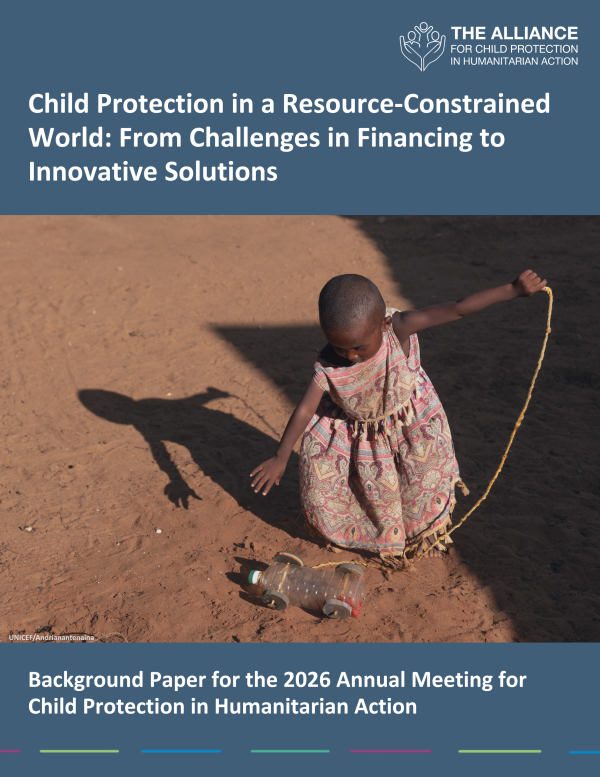
Background Paper | Child Protection in a Resource-Constrained World: From Challenges in Financing to Innovative Solutions
This background paper sets the scene for the 2026 Annual Meeting for Child Protection in Humanitarian Action, examining how escalating humanitarian needs, acute funding cuts, system-wide reforms, and the erosion of international humanitarian and human rights law are reshaping the operating...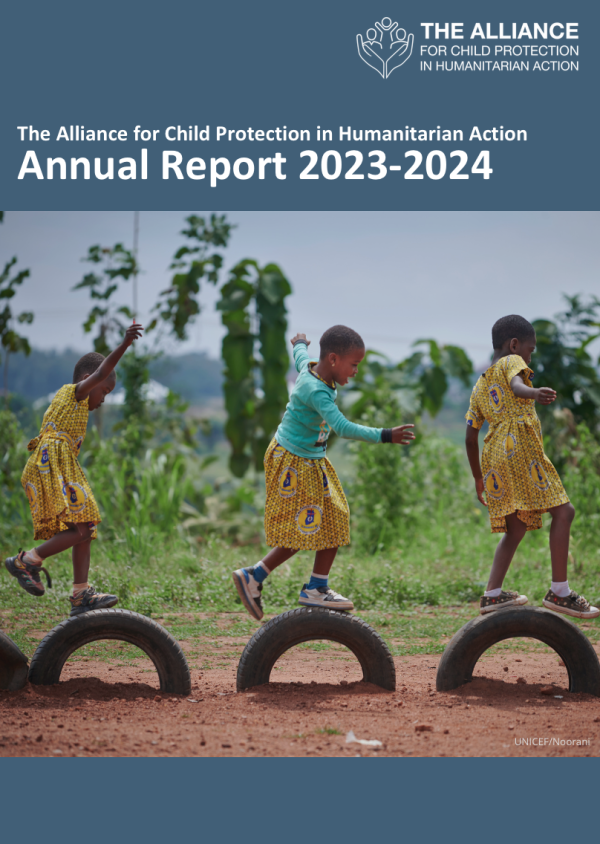
2023-2024 Annual Report | The Alliance for Child Protection in Humanitarian Action
The Alliance for Child Protection in Humanitarian Action (the Alliance) is a global network that facilitates inter-agency technical collaboration on child protection in all humanitarian contexts. This 2023-2024 Annual Report provides a summary of the Alliance’s activities and accomplishments guided...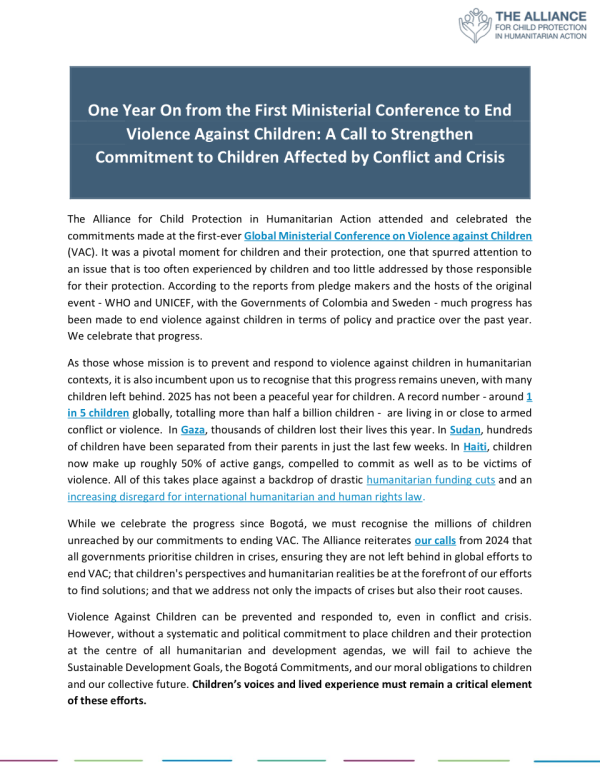
One Year On from the First Ministerial Conference to End Violence Against Children: A Call to Strengthen Commitment to Children Affected by Conflict and Crisis
It’s been one year since the first Global Ministerial Conference to End Violence Against Children, held in Bogotá in 2024 — a milestone moment that united governments and partners around a shared vision: A world where every child grows up safe and free from violence. Since then, there’s been...
Case Management Forms Video Series
Appropriate documentation by caseworkers is essential for effective and accountable child protection case management. The Case Management Forms — updated in 2024 — support consistent, ethical, and informed practice across humanitarian contexts. Each short video in this playlist explains the purpose...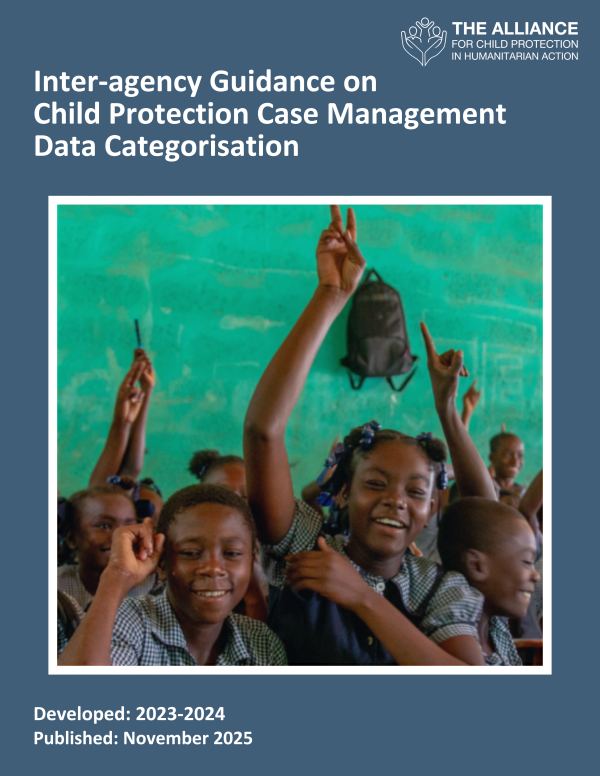
Inter-agency Guidance on Child Protection Case Management Data Categorisation
Watch the Global Launch of the Guidance on Child Protection Case Management Data Categorisation here . Child Protection Case Management (CPCM) is a cornerstone of child protection in humanitarian settings. While numerous tools and guidelines exist, there is an opportunity to utilise CPCM data more...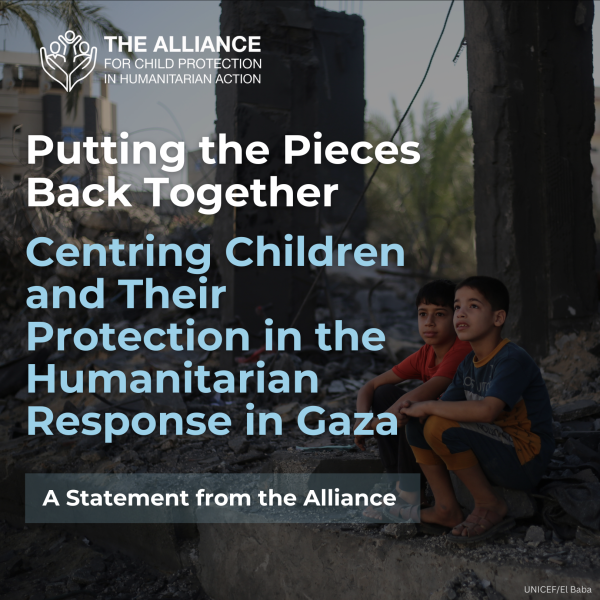
Putting the Pieces Back Together: Centring Children and Their Protection in the Humanitarian Response in Gaza
With the ceasefire in Gaza and the scale-up of humanitarian assistance, the Alliance for Child Protection in Humanitarian Action calls for children’s protection to be placed at the centre of the response. This statement outlines urgent priorities to meet the needs of Gaza’s 1.1 million children —...
Report | CPHA Practitioners Survey - Capacity and Learning Needs
The Alliance for Child Protection in Humanitarian Action (The Alliance), the Global Child Protection Area of Responsibility (CP AoR), and UN Refugee Agency (UNHCR) conducted a joint survey on Capacities and Learning Needs in Child Protection in Humanitarian Action from May to August 2024. This joint...
Briefing Note: The Impact of UN80, the Humanitarian Reset, and Funding Cuts on the Children and Armed Conflict (CAAC) Agenda
This note outlines how ongoing reforms, in particular the Humanitarian Reset and UN80 Initiative, underpinned by deepening funding cuts, risk undermining the Children and Armed Conflict (CAAC) agenda. It provides recommendations to ensure that critical gains that have been made to address the...
Children Associated with Armed Forces and Armed Groups Task Force - Offer of Support
This Offer of Support outlines how the Children Associated with Armed Forces and Armed Groups (CAAFAG) Task Force coordinates humanitarian and development actors to strengthen quality programming that prevents recruitment, facilitates release, and responds to the needs of CAAFAG in emergencies and...
Joint Statement on the International Day to Protect Education from Attack
On the International Day to Protect Education from Attack, the Inter-agency for Education in Emergencies and the Alliance for Child Protection in Humanitarian Action jointly condemn all forms of attacks on education and call for all parties to conflict to respect international humanitarian law, to...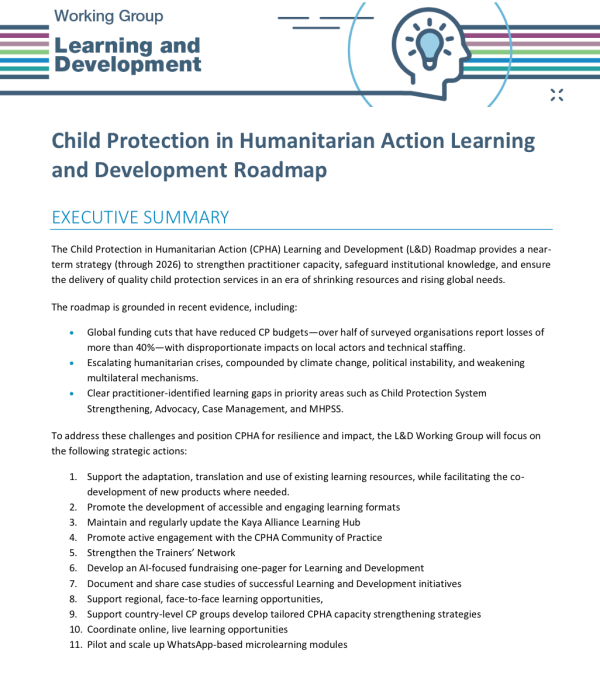
Child Protection in Humanitarian Action Learning and Development Roadmap
The Child Protection in Humanitarian Action (CPHA) Learning and Development (L&D) Roadmap provides a near-term strategy (through 2026) to strengthen practitioner capacity, safeguard institutional knowledge, and ensurethe delivery of quality child protection services in an era of shrinking resources...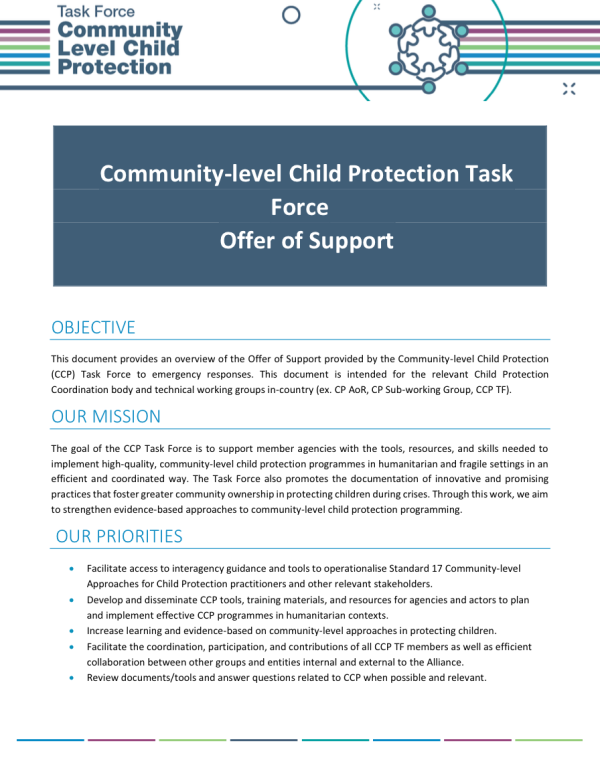
Community-level Child Protection Task Force - Offer of Support
This Offer of Support outlines how the Community-level Child Protection (CCP) Task Force supports member agencies by providing the tools, resources, and skills needed to implement high-quality, community-level child protection programmes in humanitarian and fragile settings in an efficient and...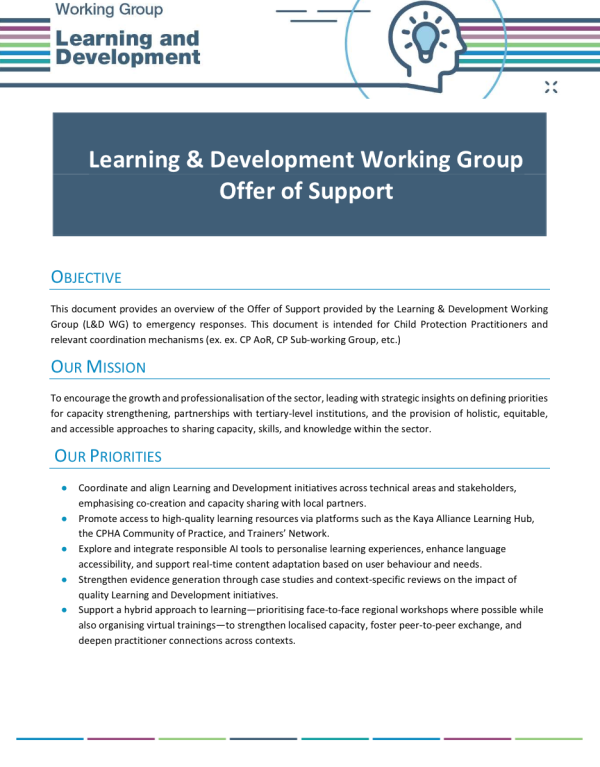
Learning & Development Working Group - Offer of Support
This Offer of Support outlines how the Learning & Development (L&D) Working Group encourages the growth and professionalisation of the sector, leading with strategic insights on defining priorities for capacity strengthening, partnerships with tertiary-level institutions, and the provision of...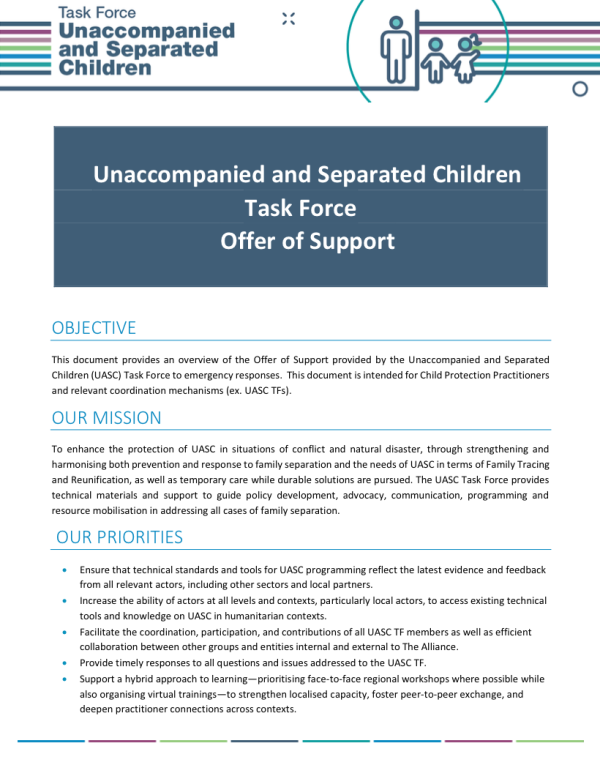
The Unaccompanied and Separated Children Task Force - Offer of Support
This Offer of Support outlines how the Unaccompanied and Separated (UASC) Children Task Force provides technical materials and support to guide policy development, advocacy, communication, programming, and resource mobilisation in addressing all cases of family separation. It highlights the UASC...
Report | An Overview of the 2025 Annual Meeting for Child Protection in Humanitarian Action
From the 3rd to the 5th of June, 841 participants from across the globe—including practitioners, donors, academics, policymakers, youth and child advocates, and community leaders—came together for the 2025 Annual Meeting for Child Protection in Humanitarian Action, hosted by the Alliance for Child...
Blog Series | 2025 Annual Meeting for Child Protection in Humanitarian Action
The 2025 Annual Meeting of the Alliance for Child Protection in Humanitarian Action convened more than 800 participants around a vital theme: Protection of Children from the Ground Up – Enhancing Localised Approaches in Conflict and Crises. At a time when conflicts are intensifying, funding is...
Strategic Brief | Prioritising Protection of Children in a Changing Humanitarian Landscape
This Strategic Brief outlines how the Alliance for Child Protection in Humanitarian Action (the Alliance) will support the sector in mitigating the impact of reduced resources and structural shifts in the humanitarian system. It focusses on sustaining the ability of humanitarian actors to deliver...
Primary Prevention Framework for Child Protection in Humanitarian Action, Revised Edition - 2024
Child Protection in Humanitarian Action (CPHA) is “the prevention of and response to abuse, neglect, exploitation and violence against children in humanitarian action.” While significant effort and improvements have been made in the sector on responding when harm has already taken place, less focus...
Report | Alternative Care Survey
Children affected by armed conflict, displacement, and natural disasters are at greater risk of being separated from their families, leading to increased vulnerability. Strengthening alternative care systems is critical to ensuring their protection, development and wellbeing. Since 2013, the...
Child Protection Minimum Standards Accountability to Children Toolkit
Since their launch in 2012, a broad range of humanitarian actors now work with the Minimum Standards for Child Protection in Humanitarian Action (the CPMS) to better protect children facing violence, abuse, exploitation or neglect in emergencies around the world. Through the CPMS and our 10 sector...
The Alliance Flyer (2025)
This flyer provides a brief overview of the structure and activities of the Alliance for Child Protection in Humanitarian Action (the Alliance) in 2025.
Analytical Report | Review of Child Protection Case Management Data
This Analytical Report presents the findings of child protection case management data extracted from the Child Protection Information Management System (CPIMS+) in six humanitarian settings: Bangladesh, Kenya, Lebanon, Myanmar, Nigeria, and Ukraine. Conducted by UNICEF with support from the US...
Agenda for the 2025 Annual Meeting for Child Protection in Humanitarian Action
Explore the agenda for the 2025 Annual Meeting for Child Protection in Humanitarian Action, taking place from 3–5 June on Zoom. This year’s theme— Protection of Children from the Ground Up: Enhancing Localised Approaches in Conflict and Crises—brings together practitioners, policymakers, and...