
Children Who are at Risk of Their Protection Rights Being Violated (CPMS)
Protection risks of children, their families, and their communities are exponentially compounded and increased during crises. Understanding historical and crisis-specific vulnerabilities and disparities in services allows both sectors to approach planning, interventions, and policy-making from a more informed perspective. As both sectors explore programmatic interventions, consider the following questions:
- How do these specific circumstances and experiences of each high-risk population impact a child’s ability to safely and fully access and participate in learning?
- What are the specific barriers or challenges that prevent or limit access and participation?
- Are existing learning interventions able to accommodate children’s specific protection and learning needs with no, little, or substantial additional inputs? What inputs are required?
- Are government policies and school cultures/infrastructure welcoming, explicitly mitigate protection risks, and foster equity now and for the future?
Protection risks of children, their families, and their communities are exponentially compounded and increased during crises. Understanding historical and crisis-specific vulnerabilities and disparities in services allows both sectors to approach planning, interventions, and policy-making from a...
When gender-responsive, quality education is available to all it has the potential to transform societies and build sustainable peace. A joint initiative from the Inter-agency Network for Education in Emergencies (INEE), Education Cannot Wait (ECW) and the UN Girls’ Education Initiative (UNGEI), the...
Around the world today, girls are more than twice as likely as boys to drop out of education when conflict or wars break out. If women could simply complete a primary education, maternal deaths could be reduced by 66 per cent. Women are paid 24 per cent less than men on average for the same work...
Developed by Plan International Canada, the GRPTT creates a foundation for gender responsiveness which is applicable for day-to-day teaching practice. Gender considerations are integrated across all modules, including lesson and course planning, materials development, and positive discipline.The...
This brief offers practical guidance for engaging men and boys in gender equity in and through education in emergencies (EiE). By providing men and boys with opportunities to examine their beliefs around gender and holding and holding them accountable to gender equitable beliefs and behaviours, men...
When working on gender-transformative education in emergencies (EiE), you will likely meet with some resistance to gender concepts, policies, or programming strategies. Resistance to gender-transformative EiE often comes from people who directly or indirectly benefit from existing gender norms and...
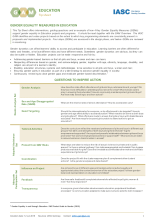
This Tip Sheet offers interventions, guiding questions and an example of how 4 Key Gender Equality Measures (GEMs) support gender equality in Education projects and programs. It should be read together with the GAM Overview. The IASC GAM identifies and codes projects based on the extent to which key...
Gender disparities in education persist in many low‐ and middle‐income countries. A clear understanding of the most effective approaches to improving education outcomes for girls, and to narrowing gender gaps, is largely missing from literature and practice. This review looks at whether...
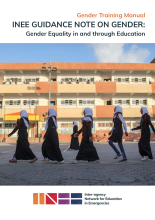
The INEE Gender Training Manual is intended to orient education practitioners to the INEE Guidance Note on Gender: Gender Equality in and through Education (2019). This training manual outlines 4-8 hours of training activities and materials related to gender-responsive education in emergencies...
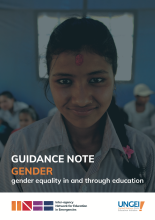
The INEE Guidance Note on Gender, an update to the 2010 Gender Pocket Guide, provides guidance on delivering education in a gender-responsive manner to anyone involved in providing education in emergencies (EiE) as part of an emergency preparedness, response, or recovery situation. This includes...
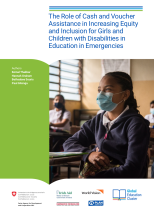
The Global Education Cluster (GEC) has been working to build the evidence base around cash and voucher assistance (CVA) in education in emergencies (EiE), resulting in the publication of the “Cash and Voucher Assistance for Education in Emergencies Synthesis Report and Guidelines” in 2019. This...
- 1184 views