
Enabling Interventions and Approaches
Across humanitarian action, there are established best practices to ensure programs clearly address children’s protection concerns and mitigate the risk of increased tensions or conflict. Much of this relies on the application of a variety of ‘lenses’ to analysis, monitoring and evaluation to ensure stakeholders have a deeper understanding of tensions, potential challenges, and opportunities to provide context-specific, relevant support to children and the programs meant to support them.
Learning from Day 1 is a practical guidance tool developed by the Global Education Cluster to support children’s learning and wellbeing from the very outset of an emergency, recognising that learning — including foundational skills, socio-emotional learning (SEL), and lifesaving knowledge — is a...
An estimated 272 million children and youth are currently out-of-school (UNESCO, 2025). Millions of these young people are accessing learning through non-formal catch-up, bridging or alternative learning programmes. Some of these are Accelerated Education Programmes (AEPs), which provide learners...
We Thrive is a Save the Children package of integrated group activities for children and adolescents to be used use in rapid onset humanitarian crises, in safe and appropriate group spaces, such as community centres, Child Friendly Spaces, Temporary Learning Spaces, Health Centers or Feeding centers...
National-level policies are vital to the realization of forcibly displaced adolescent and youth engagement in secondary education. As multiple global-level frameworks and commitments are non-binding, national-level laws and the policies formulated within them help provide the political, social, and...
These modules aim to provide school teams, including school directors, teachers and other education professionals working in or with schools, with the knowledge, skills, attitudes and tools to support the (re)enrolment of all children in schools, particularly those most marginalized, and to prevent...
This case study describes the mobile child protection programming implemented in Bogota, Colombia, responding to the needs of migrants and refugees from Venezuela and other vulnerable people in 2019.This case study describes the mobile child protection programming implemented in Bogota, Colombia...
The Accelerated Education Programme (AEP) Checklist was created as a tool for programme designers, implementers, evaluators and agencies to use alongside the AEWG Guide to the Accelerated Education Principles. The purpose of this tool is to encourage AEPs to examine how their own programmes align...
The inter-agency Accelerated Education Working Group (AEWG) reviewed and distilled a set of global good practices and guidelines for AEPs. This guide helps establish what is considered good practice, and is intended to evolve into a standard.Existing AEPs may not reach this standard. However, it is...
This policy brief offers recommendations to strengthen the policy environment within which non-formal education is delivered and highlights key considerations for those planning, designing and implementing non-formal programmes that seek to meet the core education and skill development challenges...
The purpose of this toolkit is to provide practical guidance (tools, examples, and resources) for designing a comprehensive distance learning strategy that covers an entire education sector or system.This toolkit will help users:Understand what distance learning is, why it is important, and how it...
The Guidelines and Practical Strategies for Strengthening Support to Government Authorities, School Leaders, Teachers and Community Members in their Efforts to Improve Educational Quality for All aim to provide guidance and practical strategies to key actors working to both provide and support...
In response to the challenge to education systems presented by the global COVID-19 pandemic, UNICEF and the World Bank, with funding from GPE, have created a set of global public goods in partnership with Cambridge Education to support the delivery of quality remote learning. The seven Resource...
Due to the COVID-19 pandemic, in which approximately 1.5 billion children and youth (nearly 85% of the world’s learners) were affected by school closures,1 the AEWG anticipates that catch-up programmes will be deployed extensively to meet the needs of learners who missed out on several months to...
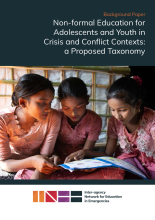
Non-formal education (NFE) programs offer an alternative to formal education for out-of-school children, adolescents, and youth, and for learners for whom the formal education system is not a good fit, providing a flexible, responsive education that is better suited to the unique circumstances of...
The Accelerated Education Programme (AEP) Monitoring & Evaluation (M&E) Toolkit was created by the AEWG for AEP implementers, evaluators, and agencies. The purpose of this toolkit is to support the design and implementation of M&E Frameworks for specific accelerated education programmes in order to...
- 653 views