
Foundational Areas of Work

Across humanitarian action, there are established best practices to ensure programs are context-specific, culturally responsive, effective, and efficient. Much of that is related to the process stakeholders take to determine the most effective and responsive programming, build relationships and work in a coordinated way with others to support families, schools / learning environments, and communities. Those practices and programming evolve as the context and needs of communities change across the life of a response. 

The protection of affected populations and provisions of basic services are the responsibilities of a country’s government. Education and Protection Clusters/coordination mechanisms must consider how their activities strengthen and support the government’s immediate and long-term response abilities.
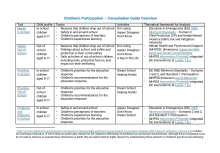
 Cover
This Terms of Reference (ToR) outlines how Education Cluster partners will conduct consultations with children as part of a broader needs assessment. It provides guidance on engaging girls and boys through safe, ethical, and participatory methods to better understand their experiences, education...
 Cover
This training presentation provides practical guidance for enumerators facilitating child participation in Joint Education Needs Assessments (JENAs). It covers the principles of meaningful and ethical child participation, safeguarding and PSEA obligations, informed consent and assent, safe...
 Cover
The purpose of this Quick Guide is to support Education Cluster Teams and Cluster partners wishing to integrate children’s participation and chid participation processes into coordinated needs assessments and analyses, particularly within Joint Education Needs Assessments (JENA). In addition to JENA...
 Cover
By the end of the session, students should be able to:Name five rights that children have.Describe Luminos Fund’s policy on corporal punishment in the classroom, and describe what they should do if they encounter corporal punishment in the classroom.Describe who a safe adult is and name a safe adult...
 Cover
The Alliance is committed to capacity strengthening for the child protection in humanitarian action workforce. Together, we develop quality learning materials and deliver them through face to face, online and blended learning opportunities.The Alliance E-Learning Hub is home to all of the Alliance’s...
Cover
This is the second booklet in a toolkit comprised of 6 booklets. The toolkit provides a conceptual framework for measuring children’s participation, together with guidance on how to undertake monitoring and evaluation and practical tools that can help you gather the information you need. It can be...
Cover
Throughout the world, more than 600 million young people live in fragile and conflictaffected contexts today. They are among the most affected by the multiple and often interlinked forms of violence – from political violence and criminal gangs to organized crime and terrorist attacks that plague...
Cover
This course contributes to building your capacity to promote, design and implement at-scale programming for meaningful adolescent participation and civic engagement. The course provides you with learning on the rational and conceptual underpinning of adolescent participation, the five key strategies...
Cover
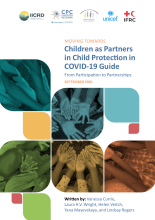
At the outset of the COVID-19 pandemic, children and youth were facing unprecedented challenges caused by quarantine measures and school closure policies in nearly every country in the world.At the same time these challenges emerged, child-focused organizations found it harder than ever to...
Cover
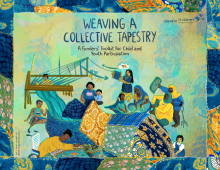
In early 2022, Elevate Children Funders’ Group commissioned a research study to better understand child and youth participatory models used by funders. The resulting Funders’ Toolkit for Child and Youth Participation, co-created by an amazing group of young leaders, and with the guidance of an...