

The Alliance is committed to developing standards and materials covering all areas related to child protection in humanitarian action and generating technical guidelines for use by humanitarian actors. The Alliance is also the custodian of the Minimum Standards for Child Protection in Humanitarian Action, which is considered a companion to the Sphere standards.
Search

2021- 2025 Work Plans | The Alliance for Child Protection in Humanitarian Action
The Alliance 2021 - 2025 Work Plan sets out the interagency standard setting and normative work of the Alliance, which aims to strengthen quality and effectiveness of child protection programs in humanitarian settings. This document should be read in conjunction with the 2021-2025 Strategy of the...
UNPROTECTED: Special Edition - Analysis of Funding for Child Protection in Armed Conflict in 2021 and 2022
The impact of armed conflict on children is one of the most pressing humanitarian concerns today. A strong humanitarian child protection response is critical to protect children and promote their rights, dignity, and resilience. This requires sustainable, flexible, multi-year funding for child...
Compendium of Resources for Family and Caregiving Strengthening in Humanitarian Settings
The Family Strengthening Task Force is pleased to present this Compendium of Family and Caregiver Strengthening Interventions and Tools! As defined in the Minimum Standards for Child Protection in Humanitarian Action (2019), family and caregiving strengthening aims to promote children’s healthy...
Mini Guide #5 | Child Protection in Outbreaks: Preventing Harm to Children in Infectious Disease Outbreaks
This Mini-Guide is aimed at humanitarian personnel working in health and child protection as well as those specialising in mental health and psychosocial support and members of the social service workforce. This Mini-Guide is for use during the preparedness, response and recovery phases of an...
Mini Guide #6 | Child Protection in Outbreaks: Prioritising Child Participation in Infectious Disease Outbreaks
This Mini-Guide aims to support children’s agency and amplify their voices, ultimately improving the overall quality and effectiveness of subsequent interventions. This Mini-Guide sets out: 'WHAT' child participation is; 'WHY' child participation is important in outbreak settings; and Strategies as...
Agenda | 2023 Annual Meeting for Child Protection in Humanitarian Action
Please find the Agenda for the 2023 Annual Meeting in English, French, Spanish and Arabic to give you a preview of the meeting! Please find the most up-to-date details regarding each session in Zoom Events under the “Sessions” tab. *Last update: 31 May
Participant Pack | 2023 Annual Meeting for Child Protection in Humanitarian Action
Please find Participant Pack for the 2023 Annual Meeting in English, French, Spanish and Arabic. It is important you that Participants review this pack carefully and familiarise yourself with the Zoom Events platform before the meeting, The Participant pack provides all the information you need to...
The Centrality of Children and their Protection in Humanitarian Action - A Visual and Written Introduction
The Alliance for Child Protection in Humanitarian Action’s 2021-2025 Strategy centres around one goal: The CENTRALITY of CHILDREN and their PROTECTION is recognised and prioritised as ESSENTIAL and LIFE-SAVING across the humanitarian system. The Alliance, in collaboration with members, key...
The Evolution of the Child Protection in Humanitarian Action Sector
Concern or disregard for vulnerable children in crisis situations is as old as humankind. How individuals, communities, and groups responded to the needs of vulnerable children and those in humanitarian contexts has varied throughout the past, based on beliefs, values, and behaviours at that time...
Guidance Note | Qualitative Assessment Approaches for the Protection of Children with Disabilities Within Humanitarian Contexts
Children with disabilities are particularly vulnerable in humanitarian settings, yet they are often not able to access the services and protection they need. While multiple factors create these barriers, a major cause is how data about children with disabilities is collected and mapped. Data...
Minimum Standards for Child Protection in Humanitarian Action
The Minimum Standards for Child Protection in Humanitarian Action 2019 Edition equip humanitarians seeking to protect children effectively with the most comprehensive and up-to-date best practice so they can deliver professional programs.
Report | From Evidence to Action: Centering Children's Voices during Infectious Disease Outbreak related School Closures and Reopenings
During 2021 and 2022, the Alliance and the Inter-agency Network for Education in Emergencies (INEE), commissioned Proteknôn Foundation for Innovation and Learning to conduct participatory research across three humanitarian settings—Lebanon, Democratic Republic of Congo, and Colombia—to explore the...
Background Paper | Child Labour and Education in Humanitarian Settings
In humanitarian situations, the risks of children being out of school and engaging in child labour are both significantly elevated, particularly for displaced, refugee, and migrant children. Hence, while education is critical for the successful prevention of and response to child labour in...
A Research Summary by and for Young People | Children during COVID-19 : How were they impacted by school closures and what we can learn for the future?
This summary was written by seventeen research and round table participants aged 12 to 17 years from Colombia, Democratic Republic of Congo and Lebanon, Laura Lee (Proteknôn) and Bethel Lulie (Proteknôn), with support from Elspeth Chapman (The Alliance), Amanda Brydon (Save the Children...
Joint Submission on General Comment 26 of the Committee on the Rights of the Child on Children’s Rights and the Environment with a Special Focus on Climate Change
This submission has been prepared by the Advocacy Working Group (AWG). Several AWG members formed a sub-group to discuss the forthcoming General Comment 26 on children’s rights and the environment with a special focus on climate change, from the perspective of child protection in humanitarian...
CPHA Learner Profiles
What are Learner Profiles? Learner Profiles are fictional characters that we create to represent a stakeholder group. Specifically, the Alliance for Child Protection in Humanitarian Action's learner profiles consider the audience of the Alliance’s work, from the perspective of learning and...
Guidance Note | Supporting Integrated Child Protection and Education Programming in Humanitarian Action
This Guidance Note supports the Alliance and INEE’s CPHA-EiE Joint Initiative by orienting both sectors to opportunities for program integration. Through collaboration, both sectors aim to deliver on the Sustainable Development Goal 4 to provide/ensure “inclusive and equitable quality education and...
Working Together
How do we, as humanitarian workers, effectively collaborate to improve children’s protection and well-being? This Inter-Sectoral Framework aims to serve as a collective steer for doing just that: centring children and their protection needs across all programs, sectors, and responses. It has been co...
CPMS Slide Deck
These are ready-to-use PowerPoint presentations to help you advocate for implementing the Child Protection Minimum Standards in your organization and build its capacity to do so. They cover the CPMS Principles, its four Pillars and the 28 Standards. They also exist in Arabic, French and Spanish.
Guidance Note | Primary Prevention of Family Separation
In 2021, the Alliance for Child Protection in Humanitarian Action published the Primary Prevention Framework for Child Protection in Humanitarian Action (the Framework). This was developed due to the recognition that whilst there has been significant progress regarding response to harm against...
Recommendations | Enhancing Collaboration between Child Protection and Food Security Actors
On October 31st, the Alliance, alongside the Global Child Protection Area of Responsibility, the Global Food Security Cluster and Plan International, organized a global online event to spotlight how food security impacts children and their protection in humanitarian contexts and recommendations for...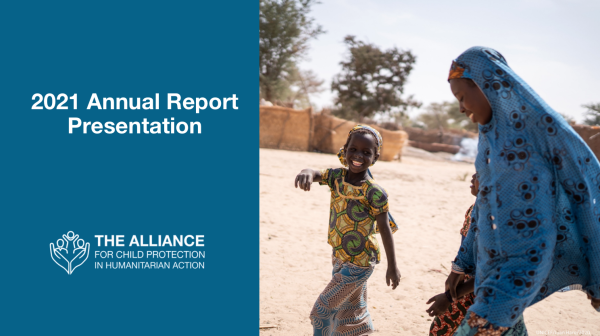
Annual Report 2022 | The Alliance for Child Protection in Humanitarian Action
This report contains an overview of some of the key activities of the Alliance Secretariat, Working Groups, and Task Forces in 2021 and priorities for 2022.
Advocacy Working Group Strategy 2021-2025
The Alliance’s Advocacy Working Group developed this advocacy strategy on behalf of The Alliance, drawing from extensive consultations with the Working Groups and Task Forces of The Alliance, members, and external actors. The advocacy strategy seeks to provide a clear vision and path for...
World Humanitarian Day 2022
There is a saying that goes: It takes a village to raise a child. Similarly, it takes a village to support a person in a humanitarian crisis. With record-high humanitarian needs around the world, this year’s World Humanitarian Day builds on this metaphor of collective endeavour to grow global...