
Safe Access and Protective Learning Environments

Safe physical learning spaces encompass a broad range of interventions that include both the presence of protective infrastructure and the absence of protection risks. Safe learning spaces promote the general well-being of learners and education personnel and enable learners to fully engage in the learning process. Determining potential hazards and protection risks is achieved through collaborative or complementary assessments that allow for essential information gathering to inform joint or integrated interventions. Interventions may address the: 

  • Physical space to mitigate protection issues, increase safety for all, and ensure infrastructure is resilient to future shocks (E.g.: site selection, accessibility of site for all, provision of gender-segregated water and sanitation facilities) and
  • Policies, practices, and behaviors (E.g.: supporting positive discipline, disciplinary policies updated and inclusive of SGBV, bullying, etc.) that reduce harm or potential risks to learners and education personnel. 

Safe access and protective learning environments are inclusive of all center-based programming with shared child protection and education interventions, including Child Friendly Spaces, ECD centers, and Formal and Non-Formal Learning Programs.
 Cover
The Menu of Measures on Gender-Based Violence Risk Mitigation in the Education in Emergencies Sector offers a compilation of validated indicators and accompanying guidance to track the effectiveness of GBV risk mitigation interventions in education in emergencies programming. This tool aims to equip...
 Cover
Globally, school-related gender-based violence (SRGBV) impacts 246 million children andadolescents a year. UNESCO defined SRGBV as “acts or threats of sexual, physical orpsychological violence occurring in and around schools perpetrated as a result of gendernorms and stereotypes and enforced by...
 Cover
En la última década la evidencia científica sobre los impactos de las crisis en el bienestar subjetivo de NNA y la población en general han hecho que las estrategias de Aprendizaje Socioemocional (ASE), Salud Mental y Apoyo Psicosocial (SMAPS) sean un componente obligado de los marcos de respuesta...
 Cover
The MHPSS and EiE Toolkit offers access to key documents and resources of relevance to those working in the fields of Education in Emergencies (EiE) and of Mental Health and Psychosocial Support (MHPSS).Education in Emergencies plays a central role in the protection and promotion of children’s...
 Cover
The sections in the Field Manual cover the basic elements for implementing the MRM. The annexes provide additional or detailed information and some specific examples that may be used or adapted for country-specific needs.
Cover
These Guidelines describe the purpose and focus of the MRM; specify the leadership, roles and responsibilities of implementing actors; describe the MRM architecture and information flow; outline reporting requirements; and highlight the critical linkage of the MRM to response programming and...
 Cover
The cost of closing schools – which at the peak of pandemic lockdowns affected 90 per cent of students worldwide and left more than a third of schoolchildren with no access to remote education – has been devastating. Children’s ability to read, write and do basic math has suffered, as has the...
 Cover
Crisis—such as conflict, natural disaster, climate change and other hazards, shocks and stresses— has a destructive impact on people and systems and can prevent states from reaching development goals. Over the past 20 years, natural disasters have affected roughly 4.4 billion people and caused US$2...
 Cover
This technical paper, commissioned by International Disability Alliance (IDA) as partof its Inclusive Education Flagship initiative, aims to inform IDA’s constituency aboutUniversal Design for Learning (UDL). Based on the thematic review of the literatureof the last 10 years, this paper aims to...
 Cover
Save the Children has developed a project that aims to link the global work done on protecting education from attack to what happens at school level in affected countries. Schools as Zones of Peace is a Save the Children led project that aims to secure boys and girls’ protection at school, and avoid...
Cover
This module outlines 3 hours (180 minutes) of training activities and materials related to psychosocial support (PSS) and social and emotional learning (SEL) in emergency contexts. It includes supplementary activities to further understanding of PSS-SEL concepts, for an extended duration of 5 hours...
Cover
The MHPSS and EiE Toolkit offers access to key documents and resources of relevance to those working in the fields of Education in Emergencies (EiE) and of Mental Health and Psychosocial Support (MHPSS).Education in Emergencies plays a central role in the protection and promotion of children’s...
Cover
The MHPSS MSP outlines a set of activities that are considered to be of the highest priority in meeting the immediate critical needs of emergency-affected populations, based on existing guidelines, available evidence and expert consensus. Each activity comes with checklists of core and additional...
Cover
Exploring Humanitarian Law (EHL) is a resource pack for teachers to introduce students aged 13 to 18 to the basic rules of international humanitarian law. It was designed by the CICR in close association with the Education Development Center, Inc. (EDC). The learning materials, which provide 36...
Cover
This Guidebook for planning education in emergencies and reconstruction aims to support educational authorities in providing equal access to education of quality for children affected by conflict or disaster.
Cover
This Framework for Action seeks to provide governments with a non-exhaustive list of suggestions, recommen- dations, and examples that can assist them as they determine the appropriate way to implement the commitments made through endorsement of the Safe Schools Declaration. It can also assist other...
Cover
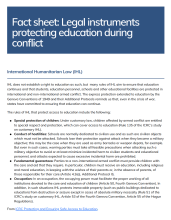
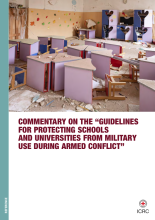
Parties to armed conflict are urged not to use schools and universities for any purpose in support of their military effort. While it is acknowledged that certain uses would not be contrary to the law of armed conflict, all parties should endeavour to avoid impinging on students’ safety and...
Cover
We are pleased to share with you the first edition of the Minimum Standards in Camp Management. These are based on the fundamental belief that the rights of all displaced persons must be respected and their needs met in a way that supports their dignity.The primary audience for these standards are...
Cover
The School Code of Conduct (SCOC) training programme is designed to be used by Save the Children education staff to enable teachers and education personnel to implement governmental Teachers’ Codes of Conduct (TCOC) in schools. The training content relates to development and emergency contexts; to...
Cover
The purpose of the Comprehensive School Safety Framework is to provide strategic guidance to duty bearers and their partners to promote safe, equitable, and continuous access to a quality education for all. The CSSF takes an “all-hazards, all-risks” approach, including: natural and climate-change...
Cover
This framework serves to inform the decision-making process on when to reopen schools, support national preparations and guide the implementation process, as part of the overall public health and education planning processes. Contextualization and continuous adaptation are necessary in order to...
Cover
The current COVID-19 outbreak has provoked social stigma and discriminatory behaviours against people of certain ethnic backgrounds as well as anyone perceived to have been in contact with the virus.
 Cover
The IRC’s Healing Classrooms approach is based on four years of action research and field testing, as well as their extensive experience in design and implementing education programs in conflict-affected areas. In the context of sudden onset and chronic crises, as well as contexts of post-crisis and...
 Cover
This volume aims to encourage concerted action by highlighting the scale and consequences of homophobic bullying and to share good policy and programming approaches. Interventions are needed at primary, secondary and tertiary levels of the education system and examples are included from all three...