
Support for Advocacy
Practitioners often need to make the case for joint and integrated programming, to explain what it is, how it works, and what the benefits are. The following resources help make the case to generalist managers, local authorities, governments and donors.
Data, evidence and other reports that can support advocacy efforts can be found in the Reports & Evidence section.
Child Protection in Humanitarian Action (CPHA) and Education in Emergencies (EiE) are highly complementary areas of humanitarian response. Conceptually, programmatically, and operationally the two sectors have much in common: both are child focused, both are priorities for affected populations, and...
At this critical juncture, we – the undersigned education experts, humanitarian leaders, civil society actors, and international organizations – convene in Helsinki with a shared sense of urgency. Across the globe, a generation of children is being left behind—not by accident, but by neglect and...
The EiE Global Advocacy Messaging Bank contains chapters of messages for clusters and partners to use in their advocacy and communications. While designed to provide coherence across sector actors, they should be adapted to each country context and/or thematic stream. These top-line messages...
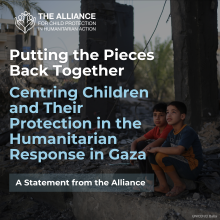
With the ceasefire in Gaza and the scale-up of humanitarian assistance, the Alliance for Child Protection in Humanitarian Action calls for children’s protection to be placed at the centre of the response.This statement outlines urgent priorities to meet the needs of Gaza’s 1.1 million children —...
Despite significant efforts, the global out-of-school rate has dropped by just 1% in the past decade. 122 million girls are still out of school today. With population growth, the number of girls missing out on education will rise unless we take urgent action. The question is not just how to get...
Nigeria has the world’s highest number of out-of-school children, with over 20 million affected by conflict and poverty. In the northeast, where insurgency has deliberately targeted education, an accelerated learning programme has shown that targeted interventions can deliver results even in fragile...

This Advocacy Resource Pack has been developed by the Alliance to support members in advocating for child protection amid funding cuts, shifting priorities, and humanitarian reform. It is a live document / interactive webpage and will regularly be updated to reflect the evolving context. The...

Children have the right to be protected from abuse, neglect, exploitation, and violence, enabling them to develop to their full potential and thrive. This is true regardless of where children live, including in humanitarian crises contexts. Children, in all their diversity, have the right to...

On 11 March 2020, the World Health Organization (WHO) declared COVID-19 a global pandemic. In response, governments around the world took the unprecedented step of closing
all schools as a way to curb the spread of the COVID-19 virus. The United Nations Educational, Scientific and Cultural...

Emergency responses to COVID-19 are intended to speed containment of the virus but can have devastating consequences for children if they ignore unique risks to their safety and fail to include specific child protection provisions. Protecting children from violence and exploitation can be life...