
Children Who are at Risk of Their Protection Rights Being Violated (CPMS)
Protection risks of children, their families, and their communities are exponentially compounded and increased during crises. Understanding historical and crisis-specific vulnerabilities and disparities in services allows both sectors to approach planning, interventions, and policy-making from a more informed perspective. As both sectors explore programmatic interventions, consider the following questions:
- How do these specific circumstances and experiences of each high-risk population impact a child’s ability to safely and fully access and participate in learning?
- What are the specific barriers or challenges that prevent or limit access and participation?
- Are existing learning interventions able to accommodate children’s specific protection and learning needs with no, little, or substantial additional inputs? What inputs are required?
- Are government policies and school cultures/infrastructure welcoming, explicitly mitigate protection risks, and foster equity now and for the future?
Protection risks of children, their families, and their communities are exponentially compounded and increased during crises. Understanding historical and crisis-specific vulnerabilities and disparities in services allows both sectors to approach planning, interventions, and policy-making from a...
When gender-responsive, quality education is available to all it has the potential to transform societies and build sustainable peace. A joint initiative from the Inter-agency Network for Education in Emergencies (INEE), Education Cannot Wait (ECW) and the UN Girls’ Education Initiative (UNGEI), the...
This guidance is primarily a self-learning tool for teachers and educators in formal, informal, or non-formal education who work with children associated with armed forces and armed groups (CAAFAG). A secondary use is to support policymaking, programming, and training to support teachers and...
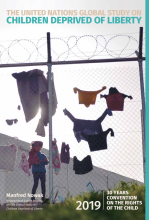
The Study provides an overview of the situation of children deprived of liberty worldwide. It includes valuable examples from States of policy options related to restorative justice, diversion, alternatives to migration detention and de-institutionalisation of children.
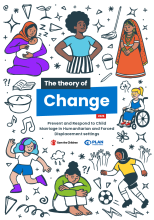
The theory of change to prevent and respond to child marriage in humanitarian and forced displacement settings has been developed as part of a collaboration between Plan International (Plan) and Save the Children (SC). The theory of change (TOC) is premised on research conducted on child marriage in...
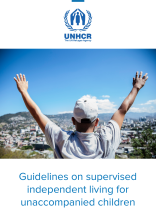
Child protection actors continue to identify unaccompanied children for whom appropriate and safe care arrangements need to be made. This includes unaccompanied children, including child-headed households, who are living without adult care, or children for whom adult/family-based care is not...
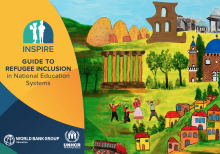
The INSPIRE Guide is intended as a resource for practitioners working on the inclusion of refugee children in national education systems. The Guide has three sections. Section I, the Guidance Note, is designed as a primer to provide clear, concise, and practical information on policy and process...
Around the world today, girls are more than twice as likely as boys to drop out of education when conflict or wars break out. If women could simply complete a primary education, maternal deaths could be reduced by 66 per cent. Women are paid 24 per cent less than men on average for the same work...
Urban warfare causes death and injury among civilians on a staggering scale. It destroys homes, communities and the social fabric. It cuts off access to health care, education, electricity, and clean water. Even so, accounts of the consequences of urban warfare for children, as a distinct segment of...
These Guiding Principles are intended to serve the purpose of promoting and spreading knowledge of international humanitarian law and, in particular, of implementing the provisions protecting children affected by armed conflicts, especially children associated or previously associated with armed...
Child, early, forced marriage and unions (CEFMU) is a severe violation of human rights and results in threats to children’s immediate and long-term wellbeing. As a child rights organisation dedicated to ensuring all children have an equal opportunity to survive, learn, and live free from violence...
This set of comprehensive guidelines outlines a framework and set of principles intended to ensure that the rights and needs of separated children are effectively addressed.Created through close inter-agency collaboration, the guidelines aim to promote and support preparedness, coordination and good...
This UNICEF working paper discusses education solutions for migrant and displaced children and their host communities.
The Global Compact on Refugees is a framework for more predictable and equitable responsibility-sharing, recognizing that a sustainable solution to refugee situations cannot be achieved without international cooperation.It provides a blueprint for governments, international organizations, and other...
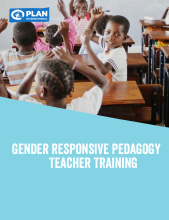
Developed by Plan International Canada, the GRPTT creates a foundation for gender responsiveness which is applicable for day-to-day teaching practice. Gender considerations are integrated across all modules, including lesson and course planning, materials development, and positive discipline.The...
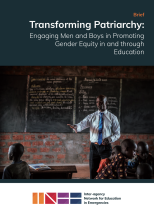
This brief offers practical guidance for engaging men and boys in gender equity in and through education in emergencies (EiE). By providing men and boys with opportunities to examine their beliefs around gender and holding and holding them accountable to gender equitable beliefs and behaviours, men...
When working on gender-transformative education in emergencies (EiE), you will likely meet with some resistance to gender concepts, policies, or programming strategies. Resistance to gender-transformative EiE often comes from people who directly or indirectly benefit from existing gender norms and...
The INEE Inclusive Education in Emergencies Training Module introduces participants to basic concepts of inclusive education in emergencies. This updated version builds on the 2011 Education in Emergencies Harmonized Training Package module and aligns with content in the Disability-inclusive...
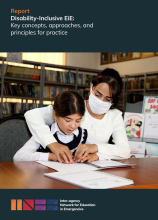
Disability-inclusive Education in Emergencies: Key Concepts, Approaches, and Principles for Practice
This report defines and clarifies key concepts and terminology for disability-inclusive education in emergencies (EiE) and provides seven guiding principles. It is meant to be used as a companion piece to the INEE Minimum Standards and to support stakeholders’ efforts to be more intentional in their...
In emergency and protracted crisis settings, there is a significant education gap for out-of-school youth. This NORCAP study focuses on the lack of educational opportunities for them.Research revealed primary education as the predominant Education in Emergencies (EiE) priority, as well as an absence...
These IASC guidelines provide a framework for working with and for young people throughout the humanitarian programme cycle (HPC), complete with tips, examples and case studies. In addition, humanitarian actors can use this guidance as a reference to design programmes that respond to their context.
Shifting Power to Young People: How Young People Can Lead and Drive Solutions in Humanitarian Action
Engaging young people in humanitarian action is however not a matter of if but how. Through interaction with close to 400 young people across 54 countries, this report concludes that young people, and particularly young women, are severely affected by emergencies and protracted crises – and are key...
This publication presents examples of policy ‘openings’ in four settings where different forcibly displaced population types are included in national education systems in different ways. For a balanced evaluation of progress in Colombia, Iraq, Nigeria, and Rwanda, policy objectives are held in...
This brief was commissioned to contribute to expert discussion within the Secondary Education Working Group. It is intended to inform advocacy, programming and learning efforts to advance secondary education which is responsive to the prevention of child marriage and the inclusion of adolescent...
This Technical Note aims to help guide programming intended to prevent and address the recruitment and use of children by armed groups in today’s conflicts. It is an output of the United Nations University’s (UNU) Children and Extreme Violence Project, which sought to fill key knowledge gaps about...
Across West and Central Africa (WCA), the prevalence of child marriage is 41%, meaning that four out of ten girls and young women, or nearly 60 million, were married before the age of 18. It is expected that, as a result of the COVID-19 crisis, child marriages will rise. Tradition is one of the...
In 2020, 36 million children were living outside of their country of birth. About one third of these children were refugees and asylum seekers.No matter where children and young people are in their migration journey- whether in transit or at destination- it is vital that their sense of belonging and...
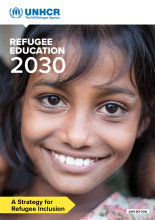
Refugee Education 2030: A Strategy for Refugee Inclusion aims to contribute directly to the following goals of the Global Compact on Refugees: Ease the pressures on host countriesEnhance refugee self-relianceSupport conditions in countries of origin for return in safety and dignityThe strategy...
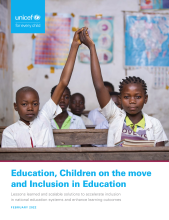
Today, the world is facing compounding humanitarian, environmental and economic crises that have spurred the migration and displacement of millions of children and their families. The number of internally displaced children, refugees, migrants, and asylum seekers and in some cases, returnees, has...
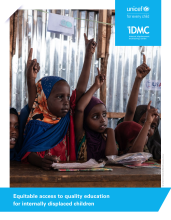
The exact number of children living in internal displacement worldwide is unknown, but there were estimated to be over 17 million at the end of 2018, as a result of conflict and violence, and millions more due to disasters. Five million youth, aged between 18 and 24, were also living in internal...
- 1184 views